Launching a Vitamin C serum under your own brand sounds simple until you actually try sourcing a stable, non-yellowing, skin-friendly formula at a price that still leaves room for profit. Most Indian brand owners discover this the hard way — after their first batch oxidises in three months or the MOQ demanded by a factory wipes out their entire seed budget. This is exactly where a reliable third party cosmetics manufacturing partner changes the game. Jack Cosmetics, based in Sanand, Ahmedabad, has been formulating and filling Vitamin C serums for D2C founders, salon chains, and established personal care brands since 2018, with a manufacturing approach built around stability testing, regulatory compliance, and realistic order quantities that actually suit a growing Indian brand.
This article walks through how Vitamin C serum manufacturing works on the ground, what separates a dependable factory from a risky one, and what you should actually ask before signing a manufacturing agreement.
Why Choose Jack Cosmetics for Vitamin C Serum Manufacturer Third Party?
The best way to judge a Vitamin C serum manufacturer isn’t by their brochure — it’s by how they handle the chemistry of an inherently unstable ingredient. Ascorbic acid (the most potent but least stable form of Vitamin C) oxidises quickly when exposed to air, light, and the wrong pH. A factory that doesn’t understand this will hand you a serum that turns brown in your customer’s bathroom cabinet within weeks.
Jack Cosmetics works with multiple Vitamin C derivatives — L-Ascorbic Acid, Sodium Ascorbyl Phosphate, Ascorbyl Glucoside, and Tetrahexyldecyl Ascorbate — chosen based on your target price point, shelf-life expectation, and skin-feel preference. The facility is ISO certified and GMP certified, with in-house stability and accelerated aging tests run before any formula goes into bulk production. With over 200 brands served and a 98% client satisfaction track record, the team has likely already solved the exact formulation problem you’re worried about.
A founder from Surat once approached us after her existing supplier’s Vitamin C batch failed pH testing twice in a row, delaying her Diwali launch by six weeks. We re-formulated using a buffered ascorbic acid system with ferulic acid as a stabiliser, and the revised batch passed both pH and centrifuge stability tests on the first attempt.
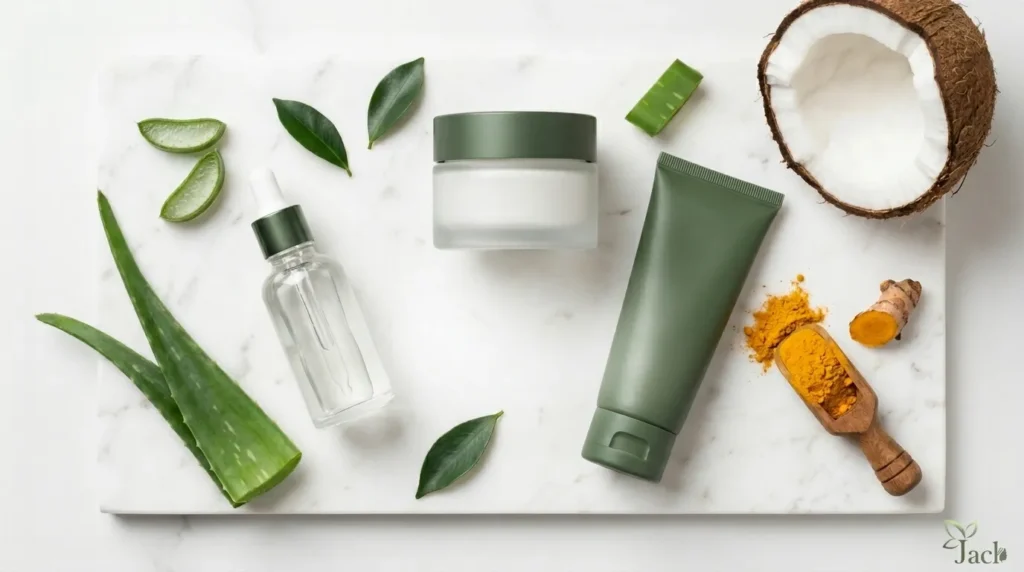
Our Vitamin C Serum Manufacturer Third Party Manufacturing Capabilities
Yes, we provide end-to-end Vitamin C serum manufacturing — from raw concept to retail-ready bottle. This isn’t limited to skin care manufacturing either. Brands working with Jack Cosmetics for serums often expand into adjacent categories under the same roof: hair care third party manufacturer lines, lip care manufacturing, body care, sun care products, oral care products, and even a men’s grooming range, all produced at the same Sanand facility.
For brands wanting a more natural positioning, the facility also handles natural & organic cosmetics and Ayurvedic cosmetics formulations, with AYUSH-compliant documentation where applicable. This matters a lot if you’re planning to market your serum with “Ayurvedic” or “herbal” claims on the label — incorrect labelling here is one of the most common reasons products get flagged during compliance checks.
A founder in Bangalore recently asked us to formulate a Vitamin C + Niacinamide combination serum for a tech-savvy, ingredient-conscious customer base. Another client in Indore wanted a simpler, fragrance-free 10% Vitamin C serum aimed at dermatology clinics. Both were produced as custom formulation projects with separate stability documentation, because the use cases — and therefore the chemistry — were genuinely different.
Navigating Regulatory Compliance & Quality Standards
Here’s how Jack Cosmetics approaches compliance: every Vitamin C serum batch goes through documentation aligned with BIS cosmetic standards, and where the formula touches drug-adjacent claims, FDA-applicable guidelines are followed for labelling and ingredient disclosure. For products carrying Ayurvedic positioning, AYUSH licensing norms are factored into the formulation and documentation process from day one — not added as an afterthought after the product is already made.
GMP certified cosmetics manufacturer status isn’t just a certificate on the wall here; it dictates how raw materials are stored (Vitamin C derivatives are light- and humidity-sensitive), how batch records are maintained, and how cross-contamination is avoided between different product lines. ISO certification covers the quality management system end to end, from vendor approval to finished goods release.
Brand owners from Delhi, Chennai, and Hyderabad frequently ask about COA (Certificate of Analysis) and MSDS documentation for export purposes — these are standard deliverables with every batch, not a special request.
Local Manufacturers vs Jack Cosmetics
| Parameter | Typical Local Manufacturer | Jack Cosmetics |
|---|---|---|
| Minimum Order Quantity | 5,000–10,000 units, often non-negotiable | Low MOQ cosmetics manufacturer options for new brands |
| Stability Testing | Often skipped or done informally | Documented accelerated aging & pH testing |
| Certifications | Varies, not always verifiable | ISO, GMP certified, AYUSH-compliant where needed |
| Formulation Flexibility | Limited to standard catalogue | Custom formulation across derivatives and actives |
| Brand Launch Support | Manufacturing only | Brand launch support including regulatory documentation |
| Supply Reach | Often regional | Pan-India supply to Mumbai, Pune, Jaipur, Kolkata, Chandigarh, Vadodara and beyond |

Step-by-Step Process – How We Deliver Vitamin C Serum Manufacturer Third Party
- Consultation & Briefing — We understand your target customer, price point, and any specific claims (brightening, anti-pigmentation, anti-aging).
- Formulation & Sampling — Lab formulates 2–3 sample variants using different Vitamin C derivatives for your evaluation.
- Stability & Compatibility Testing — Samples undergo pH, viscosity, and accelerated aging tests over several weeks.
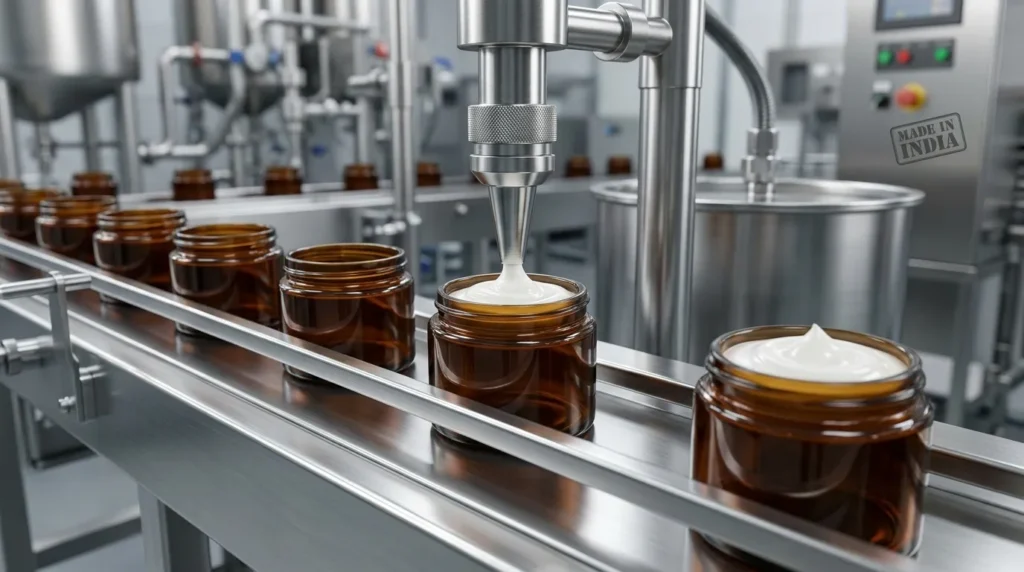
- Packaging Selection — Amber glass or airless pump bottles are recommended specifically to protect Vitamin C from light and air degradation.
- Regulatory Documentation — COA, MSDS, and label compliance review aligned with FDA and AYUSH norms where relevant.
- Bulk Production & QC — Batch manufacturing under GMP conditions with quality checks at every stage.
- Dispatch — Pan-India logistics to your warehouse, whether you’re based in Chennai, Hyderabad, or anywhere else.
This process typically takes four to six weeks from sample approval to delivery, though it can extend if a brand wants additional rounds of formulation tweaking.
Real Client Case Study
Background: A skincare startup based out of Pune approached Jack Cosmetics in early 2025 with an ambitious brief — a Vitamin C serum priced for the premium D2C segment, positioned around dermatologist-style efficacy claims, but with a vegan and cruelty-free promise.
Challenge: Their first attempt with a different vendor resulted in a serum that discoloured within eight weeks of shelf storage, and the vendor couldn’t provide stability documentation to troubleshoot the issue.
Solution: Jack Cosmetics reformulated using Sodium Ascorbyl Phosphate (a more stable derivative) combined with Vitamin E and a chelating agent to control trace metal-induced oxidation. The formula was tested across three accelerated aging cycles before bulk approval.
Result: The reformulated serum maintained colour and potency stability through 12 months of real-time testing, and the brand has since added a Vitamin C-infused under-eye gel to their range, manufactured under the same facility.
A smaller, quicker example: a Jaipur-based salon brand needed just 1,000 units of a simple Vitamin C toner-serum hybrid for an in-house retail line — handled comfortably within our low MOQ structure without compromising on testing rigour.
Frequently Asked Questions
1. What is a Vitamin C Serum Third Party Manufacturer?
- A Vitamin C Serum Third Party Manufacturer produces high-quality Vitamin C serums for brands under their own label. They manage formulation, manufacturing, packaging, labeling, and quality control, allowing businesses to launch products quickly without investing in a production facility.
2. Why should I choose a Vitamin C Serum Manufacturer Third Party in India?
- India offers cost-effective manufacturing, advanced skincare formulations, certified production facilities, and scalable manufacturing solutions. This helps brands launch premium Vitamin C serums with competitive pricing and faster turnaround times.
3. What ingredients are commonly used in Vitamin C serums?
- Vitamin C serums often contain ingredients such as Vitamin C (L-Ascorbic Acid or Ethyl Ascorbic Acid), Hyaluronic Acid, Niacinamide, Ferulic Acid, Vitamin E, Aloe Vera Extract, and botanical antioxidants to support brighter and healthier-looking skin.
4. Vitamin C Serum Manufacturer Third Party ke liye MOQ (Minimum Order Quantity) kitni hoti hai?
- MOQ manufacturer aur packaging requirements par depend karti hai. Kai third-party manufacturers startups aur emerging brands ke liye low MOQ options bhi provide karte hain.
5. Kya main apni brand ke liye customized Vitamin C Serum banwa sakta hoon?
- Haan, experienced third-party manufacturers custom formulation services offer karte hain. Aap ingredients, concentration level, fragrance, packaging design aur branding ko apni market requirements ke hisab se customize kar sakte hain.
6. How long does it take to manufacture a private label Vitamin C serum?
- The manufacturing timeline generally ranges from 3 to 8 weeks depending on formulation approval, packaging availability, label design, production quantity, and regulatory documentation.
7. Vitamin C Serum Manufacturer Third Party select karte waqt kin factors ko check karna chahiye?
- Manufacturer ki GMP certifications, quality standards, R&D capabilities, product testing process, customization options, packaging support, and delivery timelines ko evaluate karna chahiye taaki aapko reliable long-term manufacturing partner mil sake.