Herbal Shampoo Third Party Manufacturer in Ahmedabad – Custom Formulation, Low MOQ & Pan-India Supply
India’s herbal haircare market is growing fast, and brand owners who lock in a reliable manufacturing partner early are the ones building something durable. Whether you are a D2C founder in Bangalore testing a new shampoo SKU, or an established distributor in Mumbai expanding into natural haircare, getting formulation, compliance, and production right from day one decides how your brand is perceived for years. Jack Cosmetics — established in 2018 and based out of Ahmedabad, Gujarat — has quietly built a reputation among 200+ Indian brands precisely because the focus here has always been quality, not volume for its own sake.
This guide walks you through everything that matters when choosing a herbal shampoo manufacturing partner: formulation depth, regulatory compliance, what a realistic production timeline looks like, and how brands from Delhi to Chennai have scaled with third-party support. No fluff — just the practical information you actually need.
Why Choose Jack Cosmetics for Herbal Shampoo Third Party Manufacturing?
Most manufacturers will promise you a range of things on a brochure. The real test is in the details — how many botanicals they actually have validated formulas for, whether their facility holds genuine GMP and ISO certification, and whether they have handled brands at different stages of growth. Jack Cosmetic Pvt. Ltd. scores well on all three counts.
The facility at Sanand, Ahmedabad, is ISO certified and GMP certified — two credentials that matter most for export ambitions or modern retail shelves. For brands positioning their herbal shampoo as Ayurvedic, the team also assists with AYUSH licensing under the Drugs & Cosmetics Act, which is a regulatory step many first-time brand owners overlook until it’s too late. Since 2018, the company has served brands across personal care, hair care, skin care manufacturing, oral care products, body care, and sun care products — giving the in-house team a formulation breadth that is genuinely hard to replicate at smaller setups.
One early client — a wellness startup from Jaipur — came with a rough brief: a bhringraj-shikakai shampoo for men’s grooming range targeting urban professionals. The formulation team worked through five iterations before landing on a texture and foam profile the client was happy with. The brand launched at a Hyderabad trade event and saw repeat order enquiries within three months. That kind of formulation partnership is what separates a manufacturer from a contract filler.
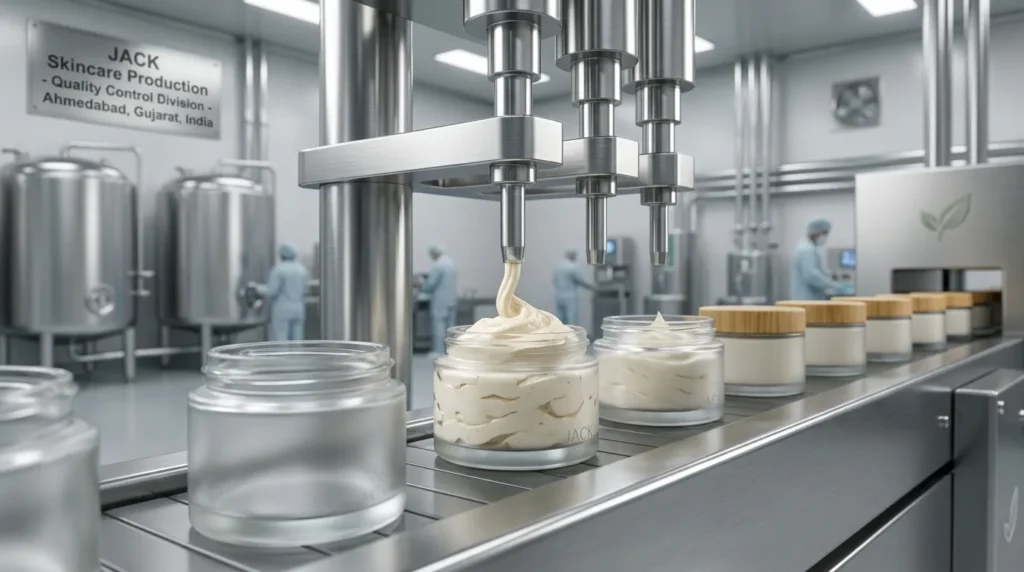
Our Herbal Shampoo Manufacturing Capabilities
Herbal shampoo formulation is more layered than people outside the industry appreciate. Getting the botanical extracts to remain stable, achieving the right pH without stripping natural oils, and balancing foam with mildness — these are real formulation challenges that require proper lab infrastructure and experienced chemists.
At Jack Cosmetics, the formulation library covers a wide range of active botanicals: amla, shikakai, reetha, neem, brahmi, bhringraj, hibiscus, curry leaf, onion extract, and more. The team can work with cold-process and heat-process systems depending on whether actives are heat-sensitive. For brands targeting the natural & organic cosmetics segment — a growing preference especially in Pune, Chandigarh, and tier-1 metros — sulfate-free, paraben-free, and silicone-free variants are well within the production capability here.
What also sets this facility apart is the flexibility on order size. A low MOQ cosmetics manufacturer approach means startups in Indore or Vadodara do not need to commit to 10,000 units on their first run. Starting at 500 units, brands can validate the market before scaling production — a practical advantage that many larger manufacturers simply do not offer.
The facility also handles end-to-end packaging — bottles, flip-top caps, pump dispensers, sachets — with in-house filling and labelling lines. Whether you want your herbal shampoo in a 200ml HDPE bottle for mass retail or a 30ml travel sachet for hospitality supply, the production line can accommodate both.
Navigating Regulatory Compliance & Quality Standards
Regulatory compliance is where many brand launches go sideways — not because of bad intent, but because the rules around cosmetic labelling, ingredient declarations, and category-specific approvals are genuinely complex. A shampoo marketed with claims like “promotes hair growth” or “clinically proven” immediately enters a different regulatory zone than one simply described as “cleansing.”
Under the Drugs & Cosmetics Act, 1940, cosmetics in India are regulated by the CDSCO (Central Drugs Standard Control Organisation). For Ayurvedic herbal shampoos, the AYUSH Ministry has additional licensing requirements if specific therapeutic claims are being made. The FDA (Food and Drug Administration) at the state level in Gujarat and Maharashtra also carries out factory inspections — which is precisely why GMP certification is not just a badge but a functional requirement.
The manufacturing team at Jack Cosmetics assists clients with:
— Ingredient INCI naming as per BIS standards
— Safe-for-cosmetics botanical extract sourcing with traceability documentation
— Batch testing records and Certificate of Analysis (CoA) for every lot
— Label compliance review including mandatory statutory declarations
— AYUSH dossier preparation for brands filing for Ayurvedic product licenses
For brands targeting exports — say, shipping herbal shampoos from Surat or Kolkata ports — the ISO-certified status of the facility and GMP documentation significantly ease the compliance requirements in GCC, UK, and Southeast Asian markets. This is a detail worth discussing upfront when you’re planning your brand’s growth roadmap.
Local Manufacturers vs Jack Cosmetics – What the Comparison Actually Shows
Brand owners, especially those evaluating private label cosmetics manufacturer India options for the first time, often compare purely on price per unit. That is understandable, but it is rarely the complete picture. Here is a more honest comparison across factors that affect your brand’s outcomes long-term.
| Parameter | Typical Local/Small Manufacturer | Jack Cosmetics (Ahmedabad) |
|---|---|---|
| GMP & ISO Certification | Often absent or lapsed | ISO Certified + GMP Certified (active) |
| Minimum Order Quantity | Varies; often 2,000–5,000 units | Starts at 500 units |
| Custom Formulation | Limited; mostly existing stock formulas | Full custom formulation with R&D iterations |
| Regulatory Support | Basic or none; brand handles compliance | End-to-end: FDA, AYUSH, CDSCO, label review |
| Ayurvedic / Herbal Range Depth | Narrow; limited botanical library | Extensive library: 30+ validated botanicals |
| Pan-India Delivery Capability | Often regional; logistics managed by brand | Pan-India supply with logistics coordination |
| Private Label & Brand Support | Minimal; product only | Brand launch support, packaging guidance |
| Client Portfolio | Limited or undisclosed | 200+ brands served, 98% satisfaction rate |
| Cruelty-Free / Eco-Friendly Compliance | Not standard | Cruelty-Free certified, eco-friendly processes |
| Make in India Alignment | Variable | Make in India certified facility |
The table above is not intended to generalise all smaller manufacturers unfairly — some do excellent work in niche segments. But when brand reputation and retail compliance are at stake, the certifications and documented processes matter more than a slightly lower per-unit cost.
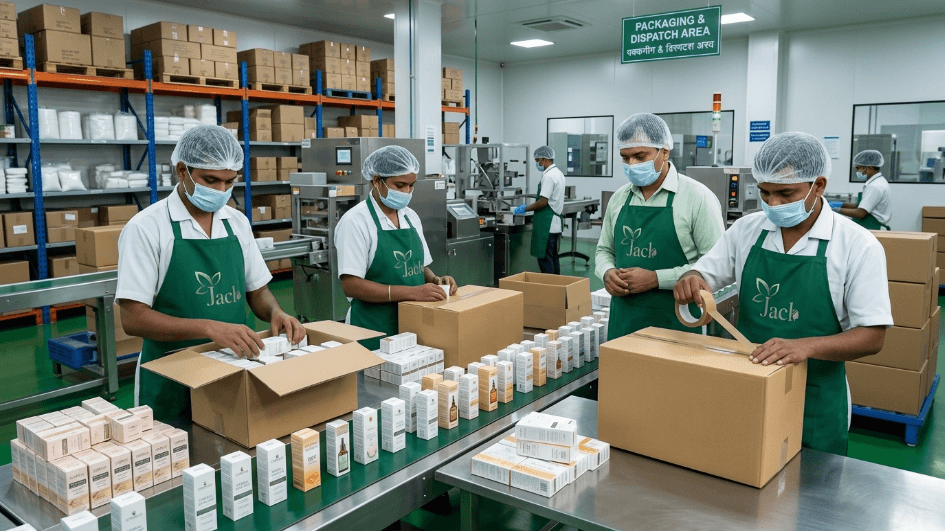
Step-by-Step Process – How Jack Cosmetics Delivers Your Herbal Shampoo
Transparency around the production process is something every brand owner deserves from their manufacturing partner. Here is how the workflow typically looks from first contact to finished goods at your warehouse — whether you’re in Ahmedabad or shipping to a Delhi 3PL centre.
Step 1 — Requirement Brief & Free Formulation Consultation
You share your target positioning (Ayurvedic, organic, anti-hair fall, scalp care, etc.), preferred key ingredients, and preferred packaging format. The formulation team reviews and asks clarifying questions. This step is free and carries no commitment.
Step 2 — Formulation Development & Sample Batch
The in-house R&D team develops a prototype formula. A physical sample is couriered to you for evaluation — fragrance, texture, foam, rinse-off feel, and colour. Typically 2–3 iterations are needed for alignment, though straightforward briefs sometimes finalise in one round.
Step 3 — Stability & Safety Testing
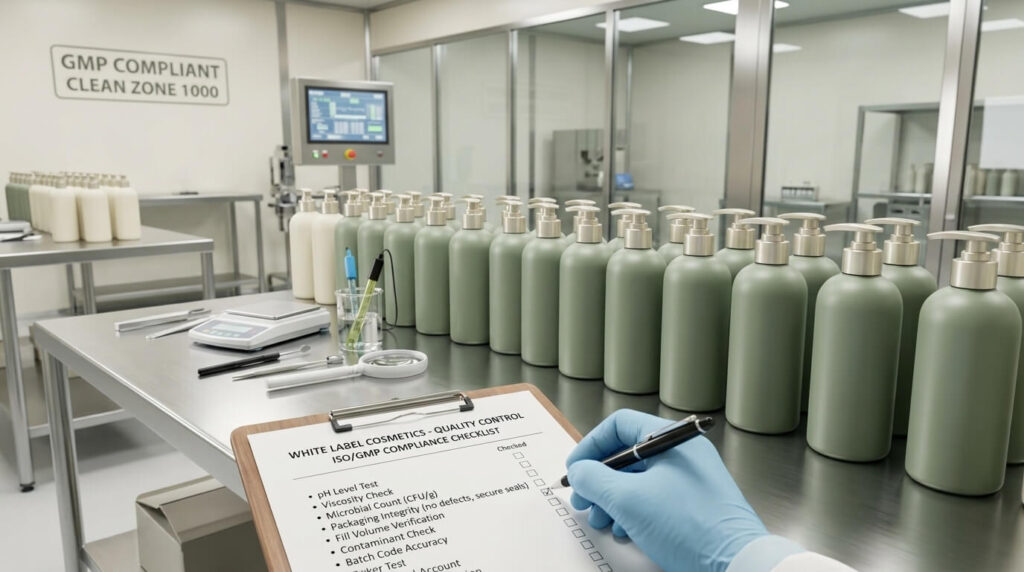
The finalised formula goes through accelerated stability testing (temperature and humidity cycling), pH verification, and microbial challenge testing. A Certificate of Analysis (CoA) is prepared for your records — useful both for retail partner requirements and future regulatory filings.
Step 4 — Packaging Finalisation & Label Compliance Review
Packaging components are sourced and confirmed. The label artwork is reviewed by the compliance team against CDSCO guidelines — MRP, net weight, ingredient list (INCI), manufacturing licence number, best-before date format, and any required AYUSH or cruelty-free claims.
Step 5 — Production Run & Quality Check
The bulk production run is carried out in the GMP-certified facility. In-process quality checks happen at every stage — mixing, pH adjustment, filling, capping, and sealing. Batch manufacturing records are maintained as per Schedule M requirements.
Step 6 — Dispatch & Pan-India Delivery
Finished goods are dispatched with documentation. Whether your delivery address is in Mumbai, Chennai, Kolkata, or a Surat fulfilment centre, the logistics are coordinated to ensure safe, on-time delivery. Most orders are fulfilled in 15–25 working days post formulation approval.
Real Client Case Study – How a Startup Built a Scalable Herbal Shampoo Brand
Client: “NaturRoots” (Name anonymised) — D2C Haircare Brand, Bangalore
Background: In late 2023, a husband-wife founding team from Bangalore approached Jack Cosmetics with a clear brief: they wanted a 100% sulfate-free, onion-bhringraj shampoo targeting urban Indians dealing with post-pandemic hair thinning — a segment they had validated through Instagram surveys. Their budget was modest, and they needed a contract manufacturing cosmetics in Ahmedabad partner who would not push them into a 5,000-unit minimum.
Challenge: Onion extract shampoos are notoriously tricky to formulate — the sulphur compounds that make onion effective for hair also make masking the odour difficult without synthetic fragrance, which the founders wanted to avoid. Three previous conversations with manufacturers had not yielded a viable solution.
Solution: The Jack Cosmetics formulation team spent two weeks working on a cold-process base with a customised essential oil blend of rosemary, tea tree, and peppermint to naturally counterbalance the sulphur note. The formula passed stability testing and client panel evaluation. The first production run was 1,000 units in a 250ml recycled HDPE bottle with a kraft-paper label aesthetic.
Result: NaturRoots sold through their first batch in 48 days via their own website and a Mumbai organic store. They are now at 6,000 units per month — a 6× scale-up within 14 months. The formulation is unchanged; only the batch size has grown.
“We couldn’t have launched without a manufacturer willing to start small and take the formulation challenge seriously,” said the co-founder. “Finding someone who understood both the product and the market was the turning point.”
Frequently Asked Questions – Herbal Shampoo Third Party Manufacturing
1. What is Herbal Shampoo Third Party Manufacturing?
- Herbal Shampoo Third Party Manufacturing allows brands to launch herbal shampoos under their own label while the manufacturer handles formulation, production, packaging, and quality control.
2. Which herbal ingredients are commonly used in herbal shampoos?
- Popular ingredients include aloe vera, amla, bhringraj, neem, hibiscus, reetha, shikakai, tea tree oil, and other botanical extracts that support scalp and hair health.
3. Can I get a customized herbal shampoo formulation for my brand?
- Yes, most manufacturers offer custom formulations based on hair concerns, ingredient preferences, target customers, and brand requirements.
4. Herbal Shampoo Third Party Manufacturing me minimum order quantity (MOQ) kitni hoti hai?
- MOQ manufacturer aur packaging requirements par depend karti hai. Kai manufacturers startups aur emerging brands ke liye flexible MOQ options bhi provide karte hain.
5. Kya Herbal Shampoo Third Party Manufacturer private labeling aur custom packaging services deta hai?
- Haan, manufacturers private labeling, custom packaging, label design, and branding support provide karte hain taaki aap apne brand name se product launch kar saken.
6. Herbal shampoo ki quality aur safety kaise ensure ki jaati hai?
- Reputed manufacturers GMP-compliant production processes, ingredient testing, stability testing, and strict quality checks follow karte hain to ensure product safety and consistency.
7. Agar mujhe sulfate-free ya Ayurvedic herbal shampoo launch karna ho to kya manufacturer help karega?
- Bilkul. Experienced manufacturers sulfate-free, paraben-free, Ayurvedic, herbal, and natural shampoo formulations develop karne me madad karte hain according to current market trends and consumer demand.