Shaving Cream Third Party Manufacturing in India – What Every Brand Owner Should Know Before Placing That First Order
India’s men’s grooming industry has shifted dramatically over the last five years. Walk into any pharmacy in Mumbai, scroll through a D2C marketplace from Delhi, or visit a modern salon in Bangalore — shaving products are now a full category, not an afterthought. For brand owners, entrepreneurs, and retail chains looking to launch or expand their men’s grooming range, the smartest and most capital-efficient path is working with a dependable third party cosmetics manufacturing partner rather than building a factory of their own. Done right, it gives you a market-ready product with validated formulation, compliance-ready documentation, and a packaging line — all without carrying the overhead of production infrastructure. But finding the right manufacturer is where most founders lose months, money, and momentum. This guide cuts through the noise.
Why Choose Jack Cosmetics for Shaving Cream Third Party Manufacturing?
Since 2018, Jack Cosmetics has been quietly doing the work that matters — building formulations, running stability tests, navigating FDA documentation, and helping brands across Gujarat, Maharashtra, Rajasthan, and beyond get their products on shelves. The team isn’t interested in being the flashiest manufacturer in the country; the focus is on delivery — consistent quality, honest timelines, and the kind of manufacturing partnership that actually helps a brand grow.
What sets a dependable shaving cream contract manufacturer apart from a mediocre one is rarely about equipment alone. It’s about formulation depth. Shaving cream is deceptively technical — it has to create a rich, stable lather that softens facial hair, protects skin from blade drag, and rinses cleanly, all while staying shelf-stable for 18–24 months. Getting any one of these parameters wrong will show up in customer reviews within weeks of launch. The team at Jack Cosmetics has handled everything from classic stearate-based brush lathering creams to modern brushless gel-hybrid formulas, and the in-house R&D capability means you’re not stuck choosing from a static product catalogue.
For a startup cosmetics brand launching from Jaipur or a mid-sized retail chain in Hyderabad adding a men’s grooming line, Jack Cosmetics offers a realistic entry point — low MOQ cosmetics manufacturer policies mean you’re not forced to commit to 10,000 units just to start a conversation. That flexibility has made it possible for over 200 brands to test, iterate, and scale without betting the company on their first production run.
The facility operates from Sanand, Ahmedabad — a location well-connected to pan-India logistics corridors. Being based in Gujarat also means manufacturers here benefit from strong chemical and raw material supply chains, keeping ingredient sourcing efficient and cost-predictable.
Our Shaving Cream Manufacturing Capabilities
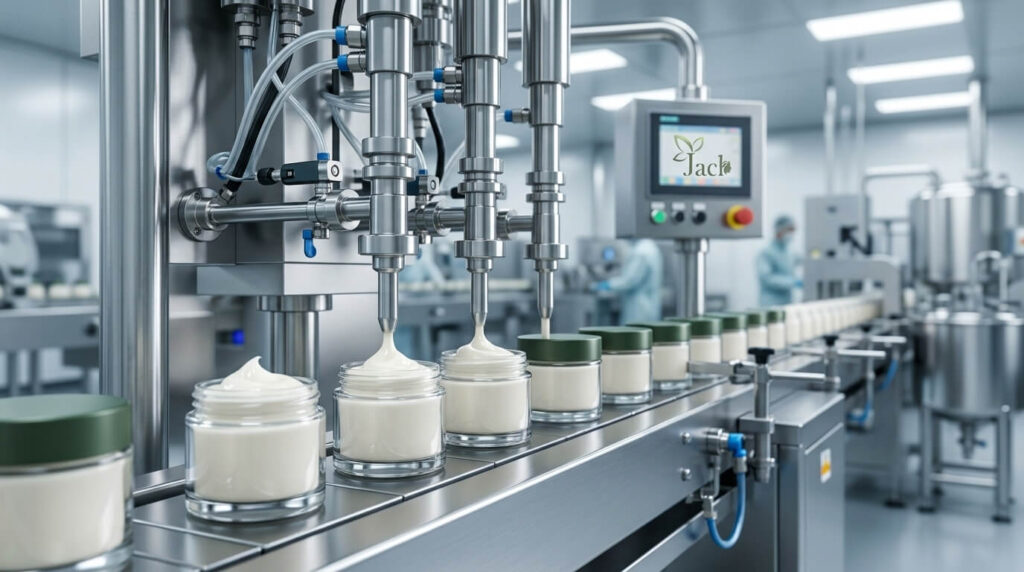
The range of shaving cream variants that can be developed here is broader than most brands initially expect. Here is an honest picture of what the manufacturing line can handle:
Classic brush lathering cream remains the most requested product — typically a stearic acid and coconut oil base, pH-balanced, with a glycerin content for skin feel. Variants with added menthol, aloe vera, or neem extract are popular for the Indian market, especially in Chennai, Pune, and Surat where consumer preference for cooling formulas is strong.
Gel-based brushless shaving cream is the fastest-growing segment among D2C brands targeting urban men between 25–40. These formulas require careful viscosity calibration and typically use carbomer or hydroxyethylcellulose as a thickener. The formulation team has worked with both synthetic and natural & organic cosmetics bases, and can develop variants certified for vegan or cruelty-free positioning.
Aerosol foam shaving cream involves a separate, pressure-tested filling line and requires coordination with aerosol-grade packaging suppliers — this is infrastructure not every third party manufacturer maintains. The process is handled end-to-end here, including compliance with Petroleum and Explosives Safety Organisation (PESO) requirements for aerosol products.
For brands targeting the Ayurvedic personal care segment, Ayurvedic cosmetics formulations with AYUSH-registered ingredients are also possible. Products like herbal shaving cream with turmeric, ashwagandha, or sandalwood can be positioned under both cosmetic and AYUSH-compliant cosmetic categories depending on the claims made. This distinction matters for labelling and marketing, and the regulatory team can guide you through it clearly.
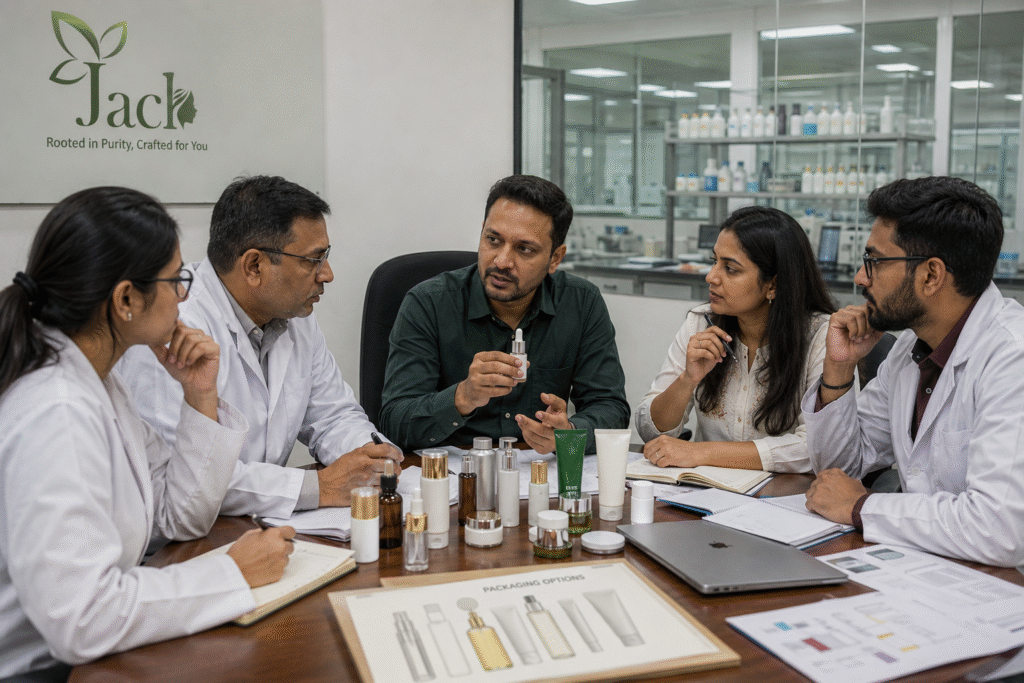
Packaging support includes tubes (aluminium and laminated plastic), jars, aerosol cans, sachets for travel packs, and pump dispensers. White label cosmetics — where you get a tested, ready formulation with your branding applied — is also available, which significantly cuts down development time for brands in a hurry to go to market.
Navigating Regulatory Compliance & Quality Standards
This is the area where most founders either rely too heavily on their manufacturer or ignore it entirely — both of which can create problems down the line. Let’s be straightforward about what’s involved.
Shaving creams fall under the Cosmetics category as per India’s Drugs and Cosmetics Act, 1940 and the subsequent Cosmetics Rules, 2020. This means the product does not require individual product registration (unlike drugs), but the manufacturing facility must hold a valid Cosmetics Manufacturing Licence issued by the state FDA. The Jack Cosmetics facility holds this licence along with GMP certification aligned with Schedule M-III standards. Brands sourcing from here can request the licence copies for their own compliance documentation.
GMP certified cosmetics manufacturer status is not just a badge — it translates into documented Standard Operating Procedures for every stage of production, from raw material receiving to finished goods dispatch. If your brand ever faces a quality complaint or a marketplace audit (Amazon, Nykaa, and others regularly conduct these), GMP documentation is what protects you. The ISO certified status further validates that quality management systems are third-party verified.
For brands exporting to the Middle East, Southeast Asia, or European markets, additional certifications like halal, vegan, or EU Cosmetics Regulation compliance may be needed. The regulatory team here has worked with brands from Chandigarh and Kolkata who sell through international D2C platforms and can advise on documentation requirements without charging consultant fees for basic guidance.
BIS labelling requirements for cosmetics — including mandatory disclosure of ingredients in INCI nomenclature, manufacturing date, best-before date, and net content — are followed as standard. Labels designed by the brand are reviewed before printing to flag any non-compliance, which saves time and avoids costly reprints.
Local Manufacturers vs Jack Cosmetics – An Honest Comparison
If you’ve been doing your research, you’ve probably received quotes from a few manufacturers — some from online directories, some through referrals. Here’s a practical comparison to help you evaluate your options more objectively:
| Parameter | Typical Small Local Manufacturer | Jack Cosmetics Pvt. Ltd. |
|---|---|---|
| GMP & ISO Certification | Often unverified or lapsed | Active GMP + ISO certification |
| Minimum Order Quantity | Usually 2,000–5,000 units minimum | Starts from ~500 units (select SKUs) |
| Custom Formulation | Limited to stock formulas | In-house R&D for bespoke formulation |
| Regulatory Documentation | Basic or incomplete | Complete — FDA licence, GMP records, MSDS |
| Ayurvedic / Natural Variants | Rarely available with AYUSH compliance | Available with AYUSH-aligned formulation |
| Aerosol Filling Capability | Usually outsourced/unavailable | In-house aerosol line (PESO compliant) |
| Brand Launch Support | Product only; no advisory | Formulation + packaging + label review |
| Pan-India Logistics | Limited to local region | Pan-India supply, all major cities |
| Client Track Record | Unverifiable or limited | 200+ brands, 98% client satisfaction |
| Cruelty-Free / Eco-Friendly Options | Not standard | Available; aligned with Make in India |
Step-by-Step Process – How We Deliver Shaving Cream Third Party Manufacturing
Here’s how the process typically works when a brand comes to Jack Cosmetics for a shaving cream manufacturing project. No two projects are identical, but this covers the standard flow:
Step 1 — Initial Brief & Consultation: You share your product concept — target user, preferred formulation style (gel, cream, foam), ingredient preferences, and packaging idea. This can happen over a call, email, or WhatsApp. There’s no charge for the initial consultation.
Step 2 — Formulation Development: The R&D team creates a prototype based on your brief. For standard formulations, this takes 5–10 working days. Formulations with unusual ingredients or specific certifications (vegan, AYUSH) may take slightly longer.
Step 3 — Sample Review & Feedback: You receive physical samples for testing. Most brands in Indore, Vadodara, and Delhi NCR have samples dispatched via courier within 2–3 days of formulation sign-off.
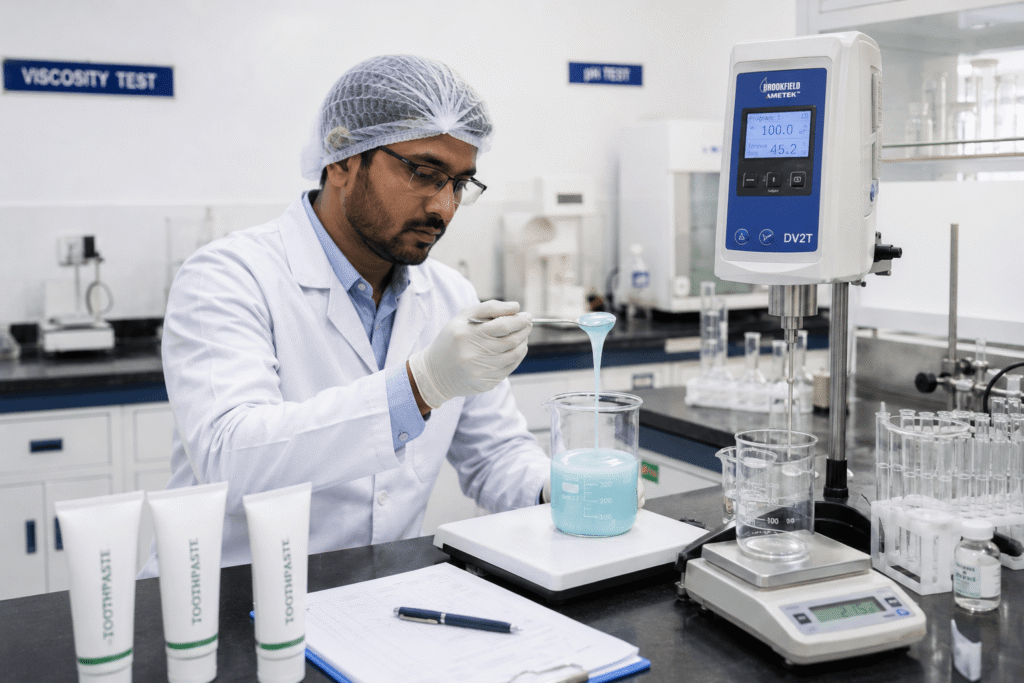
Step 4 — Stability & Safety Testing: Accelerated stability studies and basic safety assessments are conducted in-house before production confirmation. This step protects your brand from formulation failures after launch.
Step 5 — Packaging Finalisation: Tube, jar, or aerosol — the packaging team coordinates with approved suppliers. Label artwork review is included to catch any compliance gaps before printing.
Step 6 — Production & Quality Control: Full-scale production begins post-approval. Every batch goes through in-process quality checks, and a Certificate of Analysis (CoA) is provided with every dispatched lot.
Step 7 — Dispatch & After-Sales Support: Products are dispatched with complete documentation — batch records, CoA, and labelling declarations. Follow-up on reorders is typically faster as formulation and packaging records are already in the system.
Quick Story: A Mumbai Brand’s Men’s Grooming Launch
One of our clients — a Mumbai-based wellness brand — approached us in early 2024 wanting to add a men’s grooming range to their existing skincare line. They had a strong D2C presence but zero manufacturing experience. Within six weeks, they had a three-SKU shaving cream range: a classic lathering cream, a charcoal gel variant, and a cooling menthol brushless cream. Starting with a batch size of 800 units per SKU, they tested the market on their website and a regional retail chain in Maharashtra. By month four, they were reordering at 3,500 units per SKU. They now have a full men’s grooming portfolio in production.
Real Client Case Study
Case Study: “Groom Republic” – Jaipur Startup to Pan-India D2C Brand
Client (Anonymised): Groom Republic | Location: Jaipur, Rajasthan | Year: 2024–2025
Groom Republic came to Jack Cosmetics as a three-person startup with a clear vision but limited capital. They wanted a shaving cream range positioned around Ayurvedic ingredients — sandalwood and neem — targeting young urban men who preferred natural over chemical formulations. Budget constraints meant they could not commit to large MOQs upfront.
The Challenge: Most manufacturers they contacted quoted minimum 5,000 units per SKU and offered only synthetic base formulations. AYUSH-aligned ingredient sourcing was either unavailable or added a 60–70% cost premium.
What Was Done: The formulation team developed two variants — a sandalwood shaving cream with cooling agents and a neem-tulsi antibacterial variant — both using AYUSH-registered botanical ingredients at commercially viable concentrations. MOQ was set at 600 units per SKU for the first batch. Labels were reviewed for INCI compliance and Ayurvedic ingredient claims were kept within cosmetic (non-drug) boundaries to avoid licencing complications.
Results: Groom Republic launched on their own D2C site and two online marketplaces in Q2 2024. Within 90 days, the sandalwood variant sold out and they placed a reorder of 2,800 units. By Q1 2025, they had expanded to offline retail in Jaipur, Delhi NCR, and Pune. Total units manufactured crossed 15,000 in the first year. They have since added a pre-shave oil and after-shave balm to their portfolio — both manufactured here.
FAQs – Shaving Cream Third Party Manufacturing
1. What is Shaving Cream Third Party Manufacturing?
- Shaving Cream Third Party Manufacturing allows brands to outsource product manufacturing to an experienced company while selling under their own brand name.
2. Can I customize the formulation of my shaving cream?
- Yes, manufacturers offer customized formulations, including herbal, moisturizing, sensitive-skin, and premium shaving cream variants based on your market needs.
3. What certifications should I look for in a shaving cream manufacturer?
- Choose a manufacturer with GMP, ISO, and quality compliance certifications to ensure safe, reliable, and high-quality production standards.
4. Shaving Cream Third Party Manufacturing ke liye minimum order quantity (MOQ) kitni hoti hai?
- MOQ manufacturer aur packaging requirements par depend karti hai. Kai manufacturers startups ke liye low MOQ options bhi offer karte hain.
5. Kya main apni shaving cream ki packaging aur branding customize kar sakta hoon?
- Haan, aap tube design, label, fragrance, ingredients, packaging size aur branding ko apne target market ke hisab se customize kar sakte hain.
6. How long does it take to launch a private label shaving cream product?
- The timeline typically ranges from a few weeks to a couple of months, depending on formulation approval, packaging design, and production requirements.
7. Shaving Cream Third Party Manufacturing partner select karte waqt kin baaton ka dhyan rakhna chahiye?
- Manufacturer ki experience, quality standards, certifications, production capacity, customization options, aur client support ko evaluate karna chahiye before partnership.