
Cosmetic Companies in India: What Brand Owners Should Know Before Choosing a Manufacturing Partner
If you are comparing Cosmetic Companies for your next product launch, one thing becomes clear very quickly: the right manufacturing partner can save you months of trial, packaging errors, compliance issues, and working capital stress. I have seen this first-hand with founders from Mumbai, Delhi, Bangalore, and Ahmedabad who began with a simple idea—maybe a face wash, sunscreen, beard oil, or herbal lip balm—and then got stuck between formulation, approvals, MOQ, and delivery timelines. That is where an experienced manufacturer matters. Jack Cosmetic Pvt. Ltd., established in 2018 in Ahmedabad, works with brands that need practical support in formulation, packaging, quality, and scale without unnecessary complexity. If you are searching for third party cosmetics manufacturing near me, it helps to look beyond location and study process depth, regulatory understanding, and production consistency.
Why Choose Jack Cosmetics for Cosmetic Companies
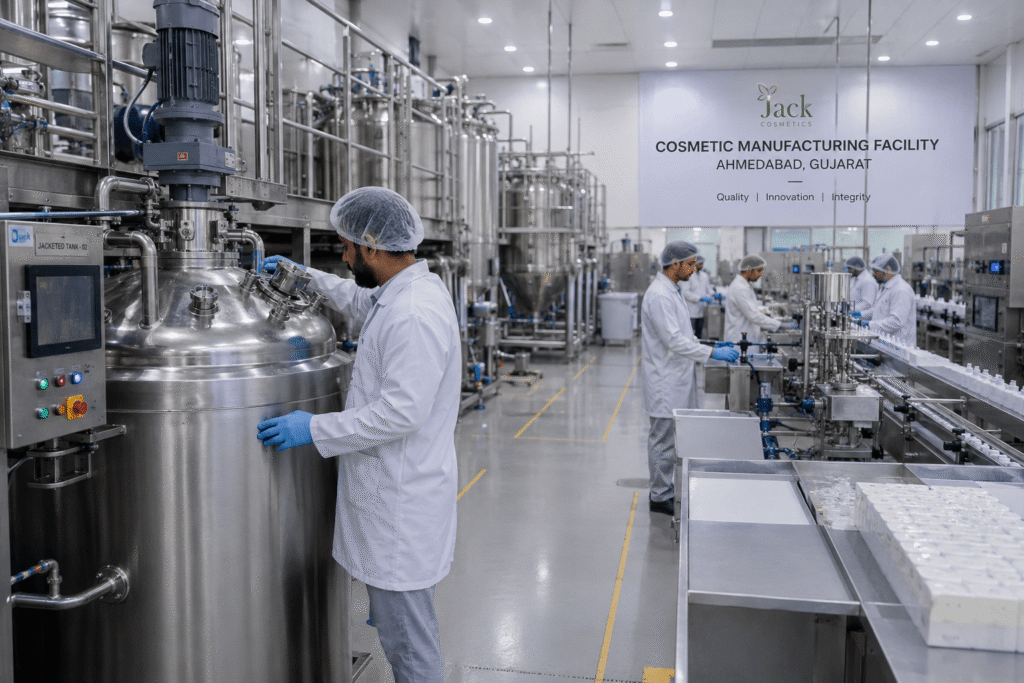
The best way to assess a manufacturer is to look at operational proof, not broad claims. Jack Cosmetics is led by an experienced team with deep formulation expertise and has delivered custom cosmetic manufacturing solutions to 200+ brands with 98% client satisfaction and high repeat business. The facility is based at Survey no.324 paiki Plot no. 10/A, Near Paradise Industrial Park, Village – Chachrawadi Vasna, Sarkhej Bavla Road, Ta. Sanand, Dist. Ahmedabad, Gujarat – 382213, India. You can review the company base and manufacturing orientation directly on the official website.
Yes, this matters even more for a startup cosmetics brand. Many founders in Pune, Jaipur, and Hyderabad start with one hero SKU and need a low MOQ cosmetics manufacturer that can support growth later. That is where practical strengths like custom formulation, scalable batch planning, pan-India supply, strict quality control, and on-time delivery make a real difference. This is also why buyers often shortlist a Private Label Cosmetics Manufacturer India only after checking whether the team can support product-market fit, packaging suitability, and repeat batch consistency.
Here’s how Jack Cosmetics usually fits different business needs. A salon-led label may need white label cosmetics for faster launch. A D2C founder may need custom formulation for differentiation. A regional distributor in Surat, Vadodara, or Indore may need body care, hair care, and sun care products under one coordinated production plan. One recent inquiry from Chandigarh was for a men’s grooming range with beard serum, face wash, and lip balm. The founder had already lost time with a small unit that could not stabilize fragrance and viscosity across batches. That kind of issue is more common than many new buyers expect.
Our Cosmetic Companies Manufacturing Capabilities
Yes, we provide a wide manufacturing range because modern personal care brands rarely grow on a single category. Jack Cosmetics supports skin care manufacturing, hair care third party manufacturer requirements, lip care manufacturing, body care, sun care products, personal care, oral care products, natural & organic cosmetics, and Ayurvedic cosmetics. If you are exploring body lotions, scrubs, shower gels, creams, or butters, the body care manufacturing page gives a useful category view.
The best manufacturing partnerships are built around formulation clarity. For example, a founder from Kolkata wanted a vitamin C face serum but needed lower tackiness for humid climates. Another buyer from Chennai wanted sunscreen texture adjusted so it would not leave a heavy white cast on medium-to-deep Indian skin tones. These are not small details. They affect repeat purchase. For brands expanding into shampoos, oils, masks, and serums, the hair care manufacturing page is relevant if your focus is ingredient-led performance with commercial batch feasibility.
Here’s what buyers often ask: can one manufacturer handle both trend-led and regulatory-conscious categories? In practical terms, yes—if the team understands formulation chemistry, ingredient sourcing, compatibility, and label compliance. That matters for white label cosmetics as much as for custom products. If your range includes SPF products, after-sun care, or daily UV defense, the sun care manufacturing page is a useful starting point to understand category support.
A small mini success story explains this well. A startup founder from Delhi came in with an idea for a compact personal care line: charcoal face wash, hair serum, and lip balm. Budget was tight. Timelines were tighter! Instead of pushing a large catalog, the team narrowed the launch to three viable SKUs, aligned packaging to available components, and phased the next two products for a later batch. That decision reduced dead inventory and helped the brand launch cleanly through online marketplaces and salon counters.
Get a Quote for Cosmetic Companies

Navigating Regulatory Compliance & Quality Standards
The best manufacturing advice I can give is simple: never treat compliance as paperwork alone. In India, cosmetic manufacturing has to align with labeling rules, ingredient suitability, batch traceability, and, depending on the category, applicable references to FDA norms, GMP systems, ISO processes, and AYUSH pathways for Ayurvedic cosmetics. Jack Cosmetics operates as an ISO certified and GMP certified cosmetics manufacturer, with FDA approved processes wherever applicable and AYUSH support for relevant herbal or Ayurvedic products.
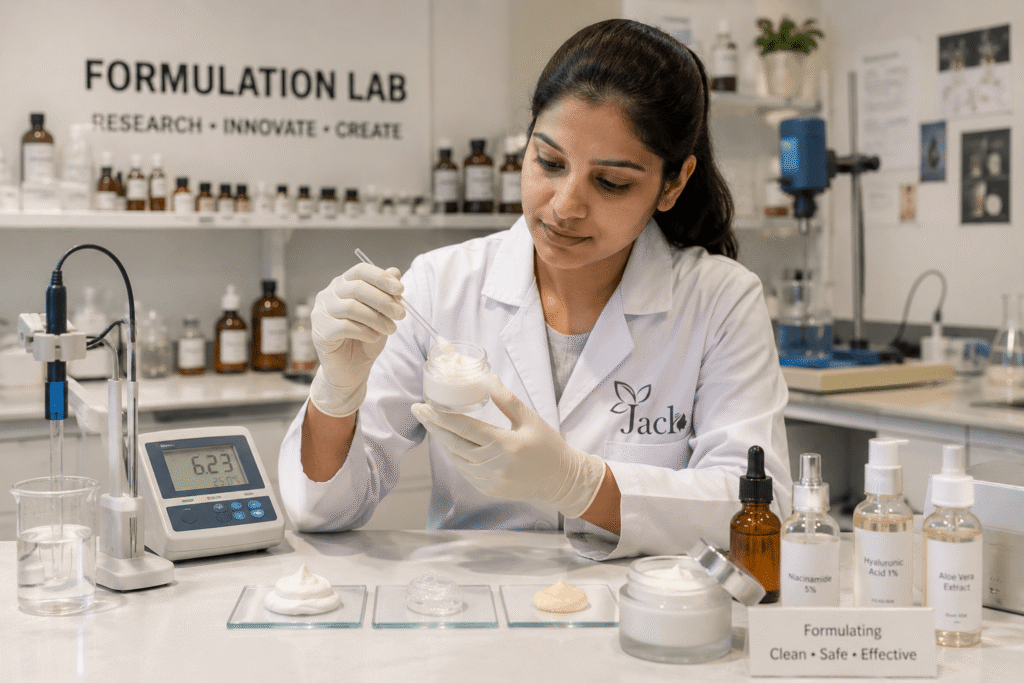
Yes, buyers ask this all the time: what does quality control look like in real life? It starts before the batch. Raw material checks, in-process monitoring, pH and viscosity testing, stability considerations, packaging compatibility, and finished goods review all matter. A lot of problems in third party cosmetics manufacturing do not come from the formula itself. They come from mismatch—cap leakage, pump failure, fragrance instability, or artwork errors. If you want a practical read on category-specific expectations, the body care blog explains several market-facing considerations.
Here’s another common question: is Ayurvedic or natural positioning easier? Not always. Natural & organic cosmetics and Ayurvedic cosmetics need even more discipline in sourcing, claims, and documentation. Many founders from Mumbai and Bangalore assume herbal positioning automatically builds trust. It can—but only when the formulation, claims, and regulatory support are aligned. For more on category planning and buyer expectations, the hair care blog is also worth reviewing.
Local Manufacturers vs Jack Cosmetics
The best comparison is not “big versus small.” It is capability versus risk. A local unit may be closer to your office, but that alone does not guarantee batch control, category depth, or pan-India logistics.
| Comparison Factor | Typical Local Manufacturer | Jack Cosmetic Pvt. Ltd. |
|---|---|---|
| Category Range | Often limited to 1–2 categories | Skin, hair, lip, body, sun, oral, men’s grooming, personal care |
| Compliance Support | Basic documentation | ISO, GMP, FDA where applicable, AYUSH support |
| MOQ Flexibility | May vary, often inconsistent | Structured support for emerging and scaling brands |
| Formulation Approach | Standard catalog focus | White label plus custom formulation options |
| Delivery Planning | Region-specific distribution | Pan-India supply with scalable production planning |
Yes, location still matters. Buyers looking for Contract Manufacturing Cosmetics in Ahmedabad often prefer Ahmedabad because it gives access to industrial support, logistics routes, and vendor ecosystems. But the smarter question is this: can the manufacturer serve Ahmedabad, Surat, Mumbai, Hyderabad, and Chennai with the same process discipline? That is where structured manufacturing usually wins. For more category insight, the sun care blog gives additional context.
Step-by-Step Process – How We Deliver Cosmetic Companies
Here’s how Jack Cosmetics generally supports a new or growing brand. First comes requirement mapping: category, target audience, pricing band, ingredient direction, packaging style, and launch channel. Second comes formulation selection, either from proven bases or through custom development. Third comes sampling and revision. Fourth comes packaging and artwork coordination. Fifth comes batch planning, quality checks, filling, packing, and dispatch. This is the stage where third party cosmetics manufacturing succeeds or fails—because coordination matters as much as chemistry.
The best founders stay closely involved during sampling. One common mistake is approving a sample under office AC conditions and not testing it in real Indian use conditions. A sunscreen that feels fine indoors may behave differently in Jaipur heat. A hair serum that works in Bangalore weather may feel heavier in Kolkata humidity. That is why feedback has to be practical, not just visual.
Yes, we also recommend lead-support tools because they help founders make better decisions faster: Free Formulation Consultation, Download our Private Label Cost Guide, and a quick WhatsApp discussion for MOQ, category fit, and expected timelines. For immediate coordination, use the contact page. Many buyers looking for private label cosmetics manufacturer India or contract manufacturing cosmetics in Ahmedabad do better when they begin with one focused category instead of trying to launch ten SKUs at once.
Real Client Case Study
Here’s how Jack Cosmetics handled a realistic scale-up project for an anonymized client, “Aarvi Naturals,” a growing brand from Pune. The founder started with a natural face wash and ubtan-inspired mask and wanted to expand into body lotion, sunscreen, and lip care before festive season. The first challenge was not production capacity. It was portfolio discipline. The original plan had seven SKUs, three pack sizes, and premium cartons for all products. That would have tied up too much inventory.
The solution was practical. The range was reduced to four launch SKUs, packaging components were standardized where possible, and the products were split into fast-moving and awareness-building lines. Regulatory documentation was aligned early, especially for claims and pack declarations. Batch planning was staggered to avoid warehouse stress. Within a controlled launch window, the brand entered online sales plus select counters in Ahmedabad and Vadodara. Reorders came first for the lotion and lip care line, which then guided the next batch plan. This is where a Third Party Cosmetics Manufacturing partner adds value—not by overloading the founder with options, but by helping make commercially sound choices.
FAQs
1. What should I check before selecting a cosmetic manufacturing company in India?
- Check certifications, category experience, formulation support, MOQ clarity, label guidance, testing process, and dispatch reliability.
2. Can a startup work with a manufacturer without large volume orders?
- Yes. Many startup brands begin with limited SKUs and phased batches, especially when they work with a manufacturer that supports flexible production planning.
3. Is white label better than custom formulation?
- It depends on your launch goal. White label is faster. Custom formulation offers stronger differentiation if timelines and budget allow.
4. Do cosmetic manufacturers help with Ayurvedic and herbal products?
- Yes, if they understand AYUSH-related requirements for applicable categories and can align documentation and claims properly.
5. Why do some cosmetic batches feel different from sample approval?
- Usually because of raw material variation, fragrance adjustment, packaging interaction, or uncontrolled batch processes.
6. Can one manufacturer handle hair care, body care, and sun care together?
- Yes, provided the facility and technical team have category capability and process controls for each product type.
7. How do I request pricing or formulation guidance?
- You can connect on WhatsApp or call +91 74909 91801 for a practical discussion around category, MOQ, and timeline. You can also ask for a Free Formulation Consultation or Download our Private Label Cost Guide.