Anti Aging Cream Private Label India – A Practical Guide for Brand Owners & Founders
India’s skincare market has changed dramatically over the last five years. Walk into any pharmacy in Mumbai or scroll through any D2C beauty platform, and you’ll find dozens of anti aging creams fighting for shelf space. Most of them, interestingly, aren’t made by the brands that sell them — they come from experienced third party cosmetics manufacturing units across Gujarat, Maharashtra, and Himachal Pradesh. If you’re a brand owner, entrepreneur, or startup founder thinking about entering this high-demand segment, understanding how anti aging cream private label manufacturing works in India is the first practical step you need to take.
This guide, based on real manufacturing experience since 2018, walks you through formulation options, regulatory compliance, what to look for in a manufacturer, and how to avoid the most common mistakes founders make when launching their first skincare product line.
Why Choose Jack Cosmetics for Anti Aging Cream Private Label India?
Jack Cosmetics, based out of Sanand, Ahmedabad, was established in 2018 with one clear goal: to help Indian entrepreneurs and established brands manufacture high-quality cosmetics without the overhead of setting up their own production unit. Since then, the company has successfully delivered custom manufacturing solutions to 200+ brands — from first-time founders in Jaipur launching Ayurvedic face creams to established distributors in Delhi expanding their product portfolios.
What actually matters when choosing a manufacturer for anti aging creams? Three things: formulation expertise, regulatory standing, and supply reliability. On all three counts, Jack Cosmetics holds ISO certification, GMP certification, and a valid State FDA license under the Drugs & Cosmetics Act, 1940 — which means your product is manufactured in a facility that meets nationally and internationally recognized quality benchmarks. The facility operates under strict Good Manufacturing Practice (GMP) guidelines as prescribed by the Central Drugs Standard Control Organisation (CDSCO), ensuring batch consistency, hygiene, and safety in every production run.
For Ayurvedic anti aging formulations — incorporating ingredients like ashwagandha, saffron, brahmi, and kumkumadi oil — the company is also equipped to handle AYUSH-compliant manufacturing, which is increasingly important as the regulatory framework around herbal cosmetics tightens in India.
One of the practical advantages for smaller brands is access to low MOQ cosmetics manufacturer services. You don’t need to commit to tens of thousands of units for your first batch — a meaningful advantage when you’re still testing product-market fit.
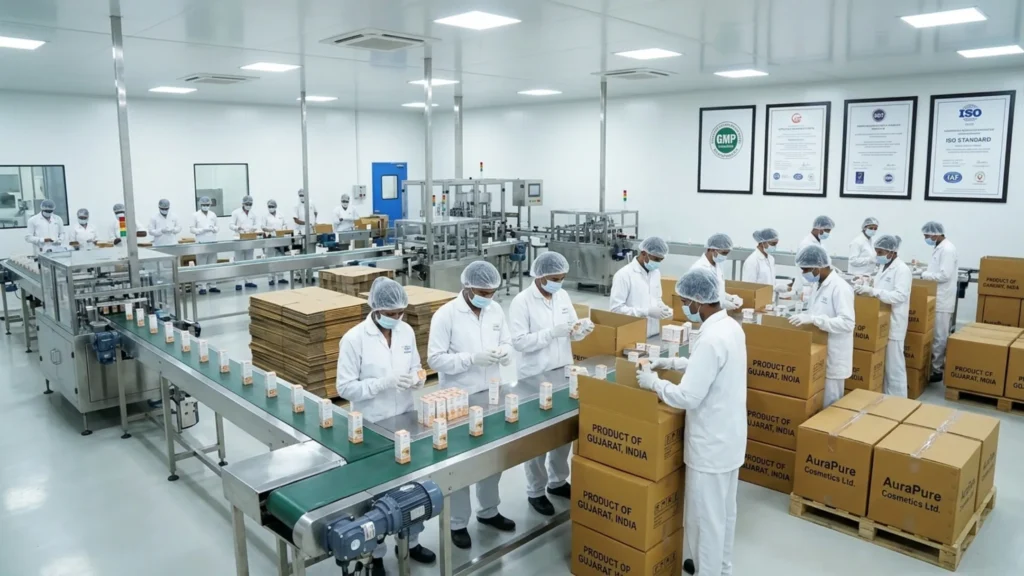
Our Anti Aging Cream Private Label India Manufacturing Capabilities
Anti aging creams are not a monolithic category. A retinol night cream requires a very different formulation environment from a vitamin C brightening day cream or a peptide-infused eye contour treatment. Here’s what the formulation range looks like in practice:
Formulation Types Available: Retinol-based creams, hyaluronic acid moisturizers, niacinamide brightening creams, vitamin C serum-creams, collagen-boosting formulations, bakuchiol creams (for clients who want a natural retinol alternative), peptide complexes, and full-spectrum Ayurvedic anti aging formulations. The R&D team can also develop custom blends from scratch if you have a specific active ingredient combination in mind.
Packaging & White Label Options: Whether you need airless pump bottles, glass jars, squeeze tubes, or eco-friendly biodegradable packaging, the facility can accommodate. White label cosmetics options allow faster go-to-market timelines for founders who need to launch quickly, while fully custom formulation routes give you a truly differentiated product. Clients from Bangalore, Pune, and Hyderabad have successfully launched D2C anti aging lines using both approaches.
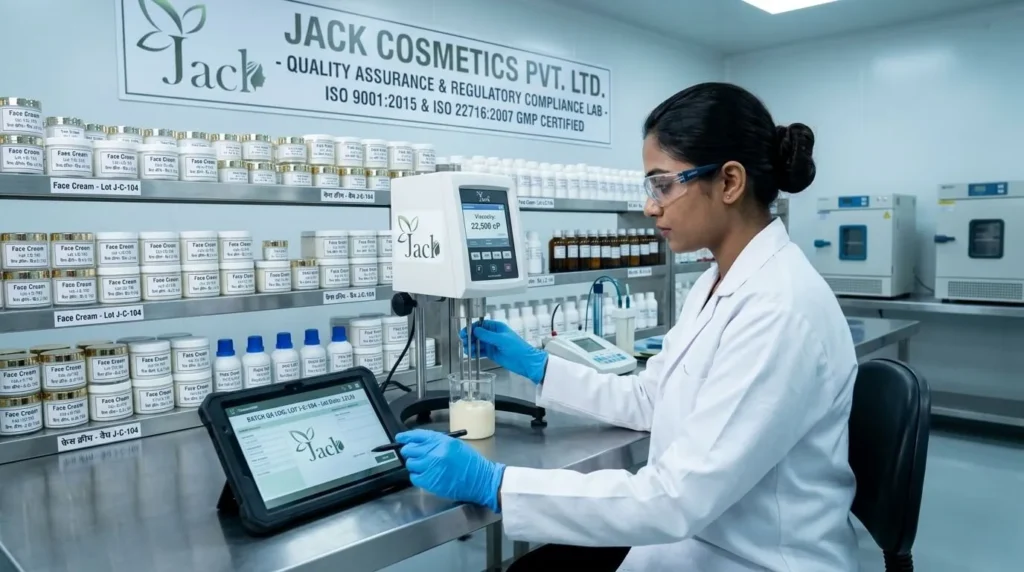
Product Testing & Stability: Every batch undergoes stability testing, microbial testing, and dermatological safety evaluation before dispatch. This is not optional — it’s a mandatory step under GMP protocols, and it’s the reason brands that manufacture here see very low return rates and high customer satisfaction scores.
Scalable Production: Startup cosmetic brand needs 500 units to test? Done. Established brand placing a 50,000-unit reorder? That’s handled too. The production lines are designed to scale with you, which is why repeat business has remained consistently high across the client base.
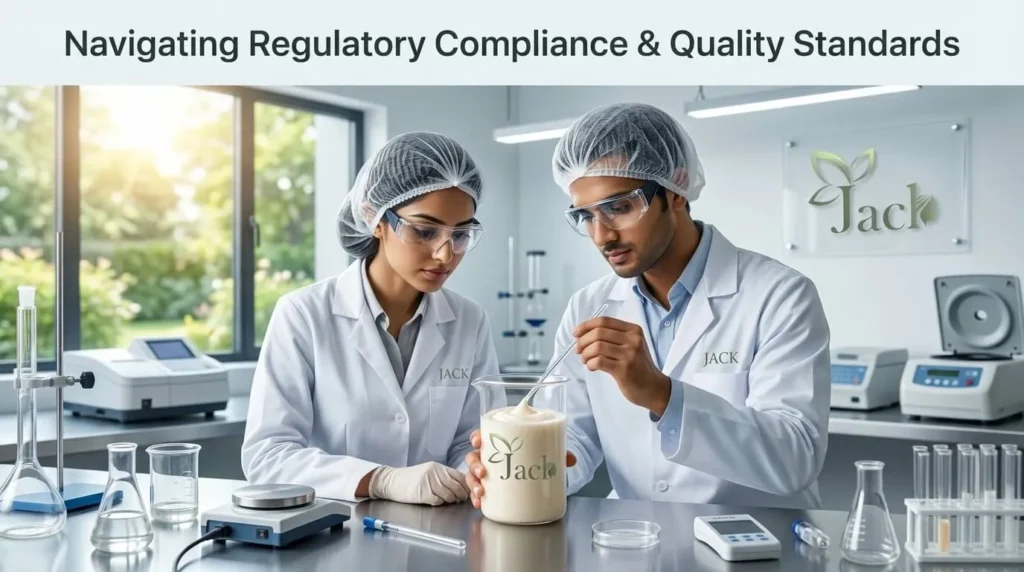
Navigating Regulatory Compliance & Quality Standards
This is where a lot of founders — especially first-timers — get tripped up. India’s cosmetics regulatory landscape is governed primarily by the Drugs & Cosmetics Act, 1940, and its Cosmetics Rules, 2020. The Central Drugs Standard Control Organisation (CDSCO) is the nodal regulatory body, and manufacturers need a valid manufacturing license from the State FDA before they can legally produce cosmetics.
For anti aging creams, the key regulatory questions are: Is the product classified as a cosmetic or a drug? Does it make therapeutic claims? These distinctions matter because they determine which license category applies. A cream that says “moisturises and firms skin” is a cosmetic. A cream that claims to “treat wrinkles at the cellular level” may attract scrutiny. Experienced manufacturers guide clients through label claim review as part of their brand launch support.
GMP & ISO Standards
Good Manufacturing Practice (GMP) guidelines — as outlined by the WHO and adopted by CDSCO — cover everything from facility hygiene and equipment calibration to batch documentation and quality control protocols. ISO certification (specifically ISO 22716 for cosmetics) adds an internationally recognised layer of quality assurance. Both are non-negotiable for any serious cosmetics manufacturer today.
AYUSH Compliance for Herbal Products
If your anti aging cream contains Ayurvedic ingredients and makes Ayurvedic claims, it falls under the Ministry of AYUSH’s jurisdiction. The Ministry of AYUSH has specific manufacturing, labelling, and licensing requirements for such products. A manufacturer with AYUSH-certified facilities simplifies this considerably.
Cruelty-Free & Eco-Friendly Manufacturing
With Indian consumers — particularly in Bangalore, Chennai, and Mumbai — increasingly conscious about ethical sourcing and sustainability, cruelty-free and eco-friendly manufacturing credentials have moved from nice-to-have to brand-building necessities. Jack Cosmetics operates under cruelty-free and eco-friendly manufacturing practices, and the Make in India certification supports the broader brand positioning for clients targeting both domestic and export markets.
Local Manufacturers vs Jack Cosmetics – Comparison
Before finalising a manufacturing partner for your anti aging cream, it helps to clearly understand what you’re comparing. Here’s an honest breakdown:
| Parameter | Typical Local/Small Manufacturer | Jack Cosmetics |
|---|---|---|
| GMP Certification | Often absent or pending | ✅ GMP Certified (CDSCO compliant) |
| ISO Certification | Rarely held | ✅ ISO Certified |
| AYUSH Capability | Limited or not available | ✅ AYUSH-ready for herbal formulations |
| Custom Formulation R&D | Minimal; standard formulae only | ✅ Full custom formulation support |
| Minimum Order Quantity | High MOQ (5,000–10,000 units typical) | ✅ Low MOQ available for startups |
| Stability & Safety Testing | Often skipped or outsourced informally | ✅ In-house stability & microbial testing |
| Pan-India Supply | Limited logistics network | ✅ Reliable pan-India supply |
| Brand Launch Support | Not typically offered | ✅ Regulatory guidance, label review, packaging support |
| Cruelty-Free / Eco-Friendly | Rare | ✅ Cruelty-free & eco-friendly operations |
| Client Satisfaction Track Record | Varies; difficult to verify | ✅ 200+ brands served, 98% satisfaction rate |
Step-by-Step Process – How We Deliver Anti Aging Cream Private Label India
Understanding the process ahead of time helps set realistic expectations and timelines. Here’s exactly how a typical anti aging cream private label project flows from enquiry to delivery:
Step 1 – Initial Consultation & Requirement Gathering: You share your target market, price point, active ingredient preferences, packaging ideas, and quantity requirements. The team reviews everything and provides an initial feasibility assessment. This consultation is free, and it saves founders in Surat, Indore, and Chandigarh a lot of back-and-forth later.
Step 2 – Formulation Development: The R&D team develops a prototype formulation. For standard white label options, this step is faster. For fully custom formulations, it typically takes 2–3 weeks and includes multiple iterations until you’re satisfied with texture, fragrance, and efficacy profile.
Step 3 – Sample Approval: You receive physical samples for evaluation. This is your chance to test on yourself, share with potential customers, or have it tested by an independent dermatologist. No production begins without your written approval of the sample.
Step 4 – Regulatory & Label Review: The compliance team reviews your proposed label, checks ingredient declarations against Schedule M and Cosmetics Rules 2020 requirements, and flags any claims that could cause regulatory issues. This is especially important for anti aging products, where boundary claims are common.
Step 5 – Production & Quality Control: Once everything is approved, production begins. Every batch is manufactured under GMP conditions, documented, tested for stability and microbial safety, and checked against the approved formula specification before release.
Step 6 – Packaging & Dispatch: Finished products are filled, sealed, labelled, and packaged as per your specifications. Delivery is coordinated with trusted logistics partners for private label cosmetics manufacturer India-wide supply, ensuring safe, on-time delivery across all states.
Real Client Case Study
Founder Story: “Aanya Skincare” – Delhi to Pan-India in 8 Months
A small success story worth sharing: In early 2024, a young founder from Delhi — let’s call her brand “Aanya Skincare” — approached Jack Cosmetics with an idea for a retinol + bakuchiol anti aging night cream targeted at women above 35 in the ₹499–₹799 price band. She had zero manufacturing background, a very limited budget, and a strong Instagram following of around 40,000 in the beauty niche.
The consultation revealed she needed a formulation that was effective but gentle — since her audience had expressed concerns about retinol sensitivity. The R&D team developed a 0.1% retinol + 0.5% bakuchiol blend in a nourishing shea butter base, which addressed the sensitivity concern while retaining visible efficacy. Three sample iterations later, she approved the formulation.
Starting with a low MOQ initial batch, she launched on her Instagram and a D2C website. Within 3 months, repeat orders began. By month 8, she had scaled to a 5,000-unit batch and listed on two major e-commerce platforms. Today, Aanya Skincare ships pan-India, covering customers in Kolkata, Vadodara, Hyderabad, and beyond. Her repeat purchase rate sits at 61% — well above industry average.
This story illustrates what’s possible when the right formulation meets the right manufacturing infrastructure, even with a limited initial budget.
Frequently Asked Questions
1. What is Anti Aging Cream Private Label Manufacturing in India?
- Anti Aging Cream Private Label Manufacturing allows businesses to launch their own branded anti-aging cream without setting up a manufacturing facility. The manufacturer handles formulation, production, packaging, labeling, and compliance while you focus on branding and sales.
2. Why should I choose an Anti Aging Cream Private Label Manufacturer in India?
- India offers cost-effective manufacturing, advanced cosmetic formulations, GMP-certified facilities, and scalable production capabilities. This helps brands launch high-quality anti-aging products with competitive pricing and faster market entry.
3. Which ingredients are commonly used in private label anti-aging creams?
- Popular ingredients include Retinol, Hyaluronic Acid, Peptides, Niacinamide, Vitamin C, Coenzyme Q10, Ceramides, and natural botanical extracts that help improve skin elasticity, hydration, and reduce the appearance of fine lines.
4. Anti Aging Cream Private Label India ke liye minimum order quantity (MOQ) kitni hoti hai?
- MOQ manufacturer par depend karti hai. Kai manufacturers startups ke liye low MOQ options bhi provide karte hain, jisse aap kam investment me apna anti-aging skincare brand launch kar sakte hain.
5. Kya main apni brand requirement ke hisab se custom anti-aging cream formula banwa sakta hoon?
- Haan, private label manufacturers custom formulation services offer karte hain. Aap ingredients, fragrance, texture, packaging aur branding ko apne target customers ke according customize kar sakte hain.
6. How long does it take to launch a private label anti-aging cream brand in India?
- The timeline usually ranges from 3 to 8 weeks depending on formulation approval, packaging selection, label design, regulatory requirements, and production volume.
7. Anti Aging Cream Private Label India me manufacturer choose karte waqt kin baaton ka dhyan rakhna chahiye?
- Manufacturer ki certifications, product quality standards, R&D capabilities, customization options, packaging support, compliance documentation, and production capacity ko evaluate karna zaroori hai taaki long-term brand growth ensure ho sake.