Sunscreen Lotion Third Party Manufacturer in Ahmedabad – A Practical Guide for Indian Brands
If you are building a sun care brand in India right now, the market timing could not be better. Dermatologist-recommended skincare, year-round UV exposure across cities like Mumbai, Chennai, and Hyderabad, and growing consumer awareness have collectively pushed sunscreen from a seasonal afterthought to a daily essential. But here is where most new brand owners hit a wall — finding a manufacturer who can actually back up their promises with formulation depth, regulatory readiness, and consistent quality, batch after batch. This guide walks you through exactly what to look for, how the process works, and how Jack Cosmetics, operating since 2018 from its facility near Ahmedabad, Gujarat, supports brands across India in launching and scaling their sun care range.
Why Choose Jack Cosmetics for Sunscreen Lotion Third Party Manufacturing?
Sunscreen is not like a basic moisturiser. It is a functional cosmetic — regulated by the Central Drugs Standard Control Organisation (CDSCO), subject to SPF testing protocols, and evaluated under Bureau of Indian Standards (BIS) guidelines for specific product claims. Choosing a partner without experience in this specific category can mean batch failures, incorrect SPF labelling, or regulatory rejections — all of which cost you time and money.
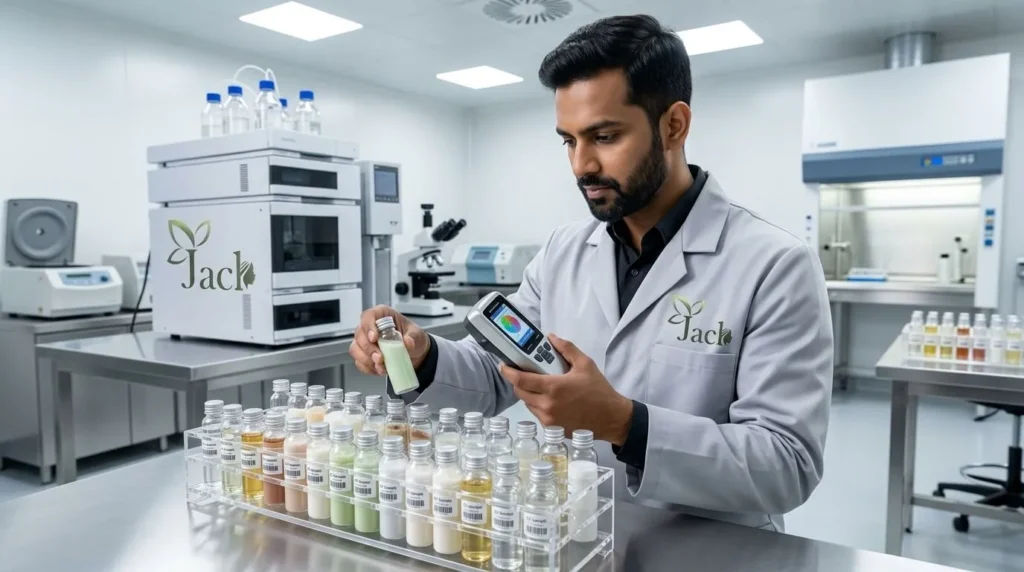
Jack Cosmetics has been working with sun care formulations as part of a broader skin care manufacturing portfolio since its founding. The team includes trained cosmetic chemists familiar with both synthetic UV filters (like Octinoxate, Avobenzone) and mineral blockers (Zinc Oxide, Titanium Dioxide), allowing them to build stable, effective formulations across SPF values. Over 200 brands — from startups in Bangalore to established distributors in Delhi — have used their manufacturing services, with a repeat business rate that speaks to consistent output quality.
One thing worth understanding: when you work with a private label cosmetics manufacturer India-based facility, you are not just outsourcing production. You are gaining access to formulation libraries, regulatory filing experience, and quality systems that would cost crores to build independently. For a young brand, that leverage is genuinely transformative.
Our Sunscreen Lotion Manufacturing Capabilities
The sun care category has expanded far beyond simple SPF 30 bottles. Brands today are launching tinted sunscreens with skin tone adaptability, blue-light protection claims, hybrid sunscreens that double as moisturisers, reef-safe formulations, and PA+++ variants marketed to urban professionals. Here is what the manufacturing setup at Jack Cosmetics actually covers:
- SPF Range: SPF 15, SPF 30, SPF 50, SPF 50+, and SPF 100+ formulations
- Protection Spectrum: Broad-spectrum UVA + UVB, PA+, PA++, PA+++ options
- Base Types: Lotion, cream, gel, serum-lotion hybrid, and spray variants
- Finish Options: Matte, dewy, invisible, and tinted finishes — including customised skin tones for Indian complexions
- Specialised Ranges: Kids’ sunscreen (mineral-only, fragrance-free), men’s matte sunscreen, sport sunscreen (water-resistant), beach sunscreen, and Ayurvedic sun protection with herbal actives like Aloe Vera, Vetiver, and Manjistha
- Custom Formulation: Briefing-to-bench formulation services where your product concept is developed from scratch by in-house chemists
- Packaging Support: Tubes, airless pumps, flip-cap bottles, mist sprayers — with custom label printing and primary packaging coordination
Brands from Jaipur have used the Ayurvedic range to position their products in Tier 2 markets with strong herbal credibility. A Chandigarh-based men’s grooming startup launched a matte-finish daily sunscreen for men using this facility’s custom formulation capability within 45 days of initial brief. The formulation flexibility is genuinely broad.
Navigating Regulatory Compliance & Quality Standards
This is where a lot of newer brand owners get blindsided. Sunscreen in India is classified as a cosmetic under the Drugs and Cosmetics Act, 1940, which means it requires proper manufacturing licences, labelling compliance, and in some states, specific FDA approvals before distribution. If you make SPF claims, those claims need to be backed by validated in-vitro or in-vivo SPF testing — not just added to the label.
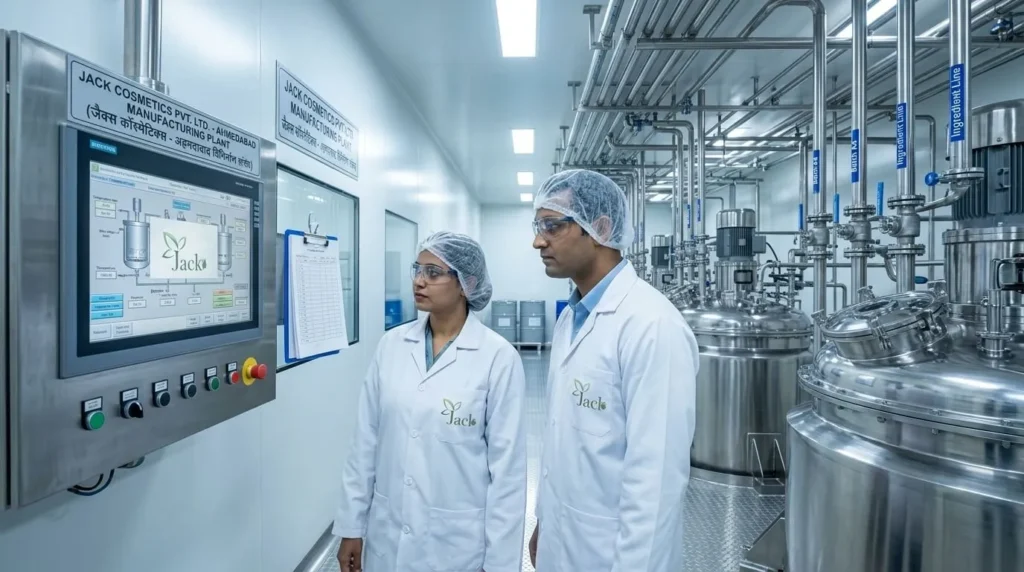
Jack Cosmetics operates with both GMP (Good Manufacturing Practices) certification and ISO certification, aligned with Schedule M requirements under Indian cosmetics regulation. For Ayurvedic sunscreen variants — increasingly popular with brands in Pune, Kolkata, and Indore — the facility also supports AYUSH licensing documentation, which is a separate compliance pathway.
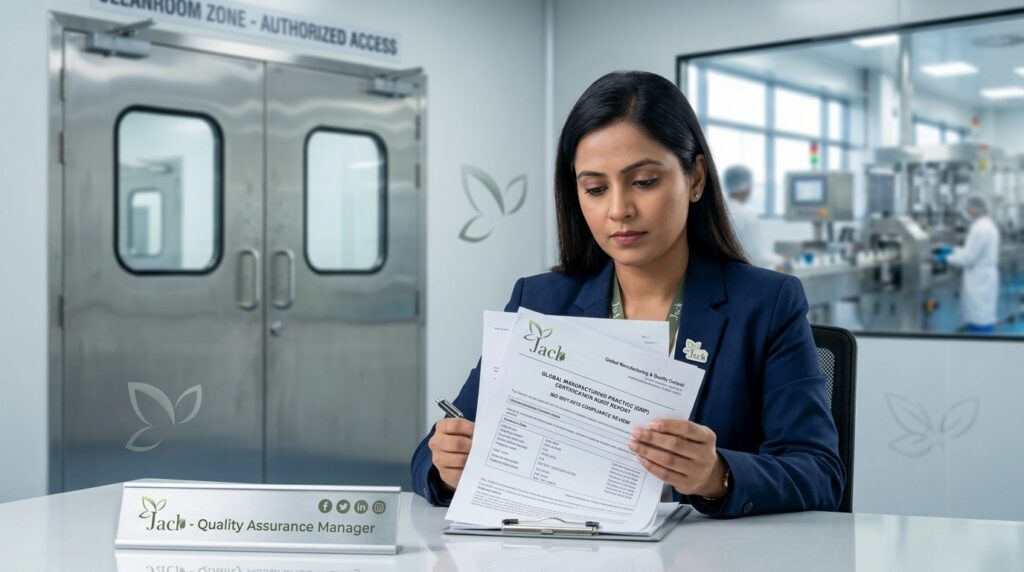
From a practical standpoint, the documentation support covers: manufacturing licence copies for your state’s FDA filing, batch manufacturing records (BMR), Certificate of Analysis (CoA) per batch, SPF testing reports from NABL-accredited labs, and stability testing data for shelf-life claims. For brands exporting to the Gulf or Southeast Asia, additional documentation support is available based on the destination country’s requirements.
International standards like ISO 22716:2007 (cosmetics GMP) and references from the International Cosmetic Ingredient Dictionary (INCI) ensure that ingredient listings on your packaging are globally accurate — a detail that matters significantly if you plan to sell through platforms like Amazon Global or Nykaa’s premium tiers.
Local Manufacturers vs Jack Cosmetics – Comparison at a Glance
Brand owners in Surat, Vadodara, and Ahmedabad often ask whether they should work with a nearby local manufacturer versus a specialised facility with a broader service range. Here is an honest, side-by-side view of what actually differs:
| Parameter | Typical Local/Small Manufacturer | Jack Cosmetics |
|---|---|---|
| Formulation Range | Limited, mostly standard formulas from a fixed catalogue | Custom formulation across SPF 15–100+, mineral, chemical, Ayurvedic, tinted, and hybrid bases |
| Certifications | May hold basic licence; GMP not always certified | ISO certified, GMP certified, AYUSH licensed, Cruelty-Free, Make in India aligned |
| MOQ | Often 5,000+ units per SKU | Low MOQ cosmetics manufacturer — starts from 500–1000 units |
| Regulatory Support | Minimal; brand owner has to manage compliance independently | Full documentation: CoA, BMR, SPF test reports, FDA & AYUSH filing support |
| Packaging Coordination | Usually not available; brand sources independently | End-to-end packaging sourcing, label printing coordination, and bulk packaging options |
| SPF Testing | Often relies on claimed SPF from ingredient supplier | Third-party validated SPF testing from NABL-accredited labs |
| Delivery & Logistics | Local/regional only; pan-India capacity uncertain | Pan-India supply with reliable logistics partners across major metros and Tier 2 cities |
| Client Satisfaction Track Record | Varies; limited references often available | 200+ brands served, 98% client satisfaction, high repeat business since 2018 |
| Brand Launch Support | Production only; no strategic support | Brand launch support including formulation brief, naming guidance, and market positioning inputs |
Step-by-Step Process – How We Deliver Sunscreen Lotion Third Party Manufacturing
A question I often get from first-time brand owners — especially those running startup cosmetics brands out of Mumbai or Delhi — is: “How does this whole process actually work?” Here is a practical breakdown:
- Initial Brief & Free Formulation Consultation: You share your product vision — target skin type, SPF value, texture preference, key actives, price point. The team at Jack Cosmetics maps this to a feasible formulation approach. This conversation is free.
- Formulation Development: The in-house cosmetic chemist team develops a prototype or selects from the existing formulation library. For custom formulations, two to three iterations are typical before sign-off.
- Sample Approval: Physical samples are shared for your internal testing, sensory evaluation, and consumer feedback. SPF testing is initiated at this stage through a third-party NABL lab.
- Regulatory Documentation: Once the formula is locked, the compliance team prepares the CoA, BMR, product dossier, and any FDA or AYUSH filing documentation you require.
- Packaging & Label Finalisation: Primary packaging (tube, bottle, airless pump) is sourced and artwork files are reviewed for regulatory labelling accuracy — INCI names, net content, MRP format, and caution statements.
- Bulk Production: Manufacturing runs through the GMP-certified facility with in-process quality checks at each stage — mixing, filling, sealing, and batch coding.
- Quality Release & Dispatch: Final batch QC is completed, Certificate of Analysis issued, and products are dispatched through logistics partners to your warehouse — whether you are in Hyderabad, Chennai, or anywhere across India.
Standard turnaround from confirmed order to delivery runs 15–30 working days depending on formulation complexity. Contract manufacturing cosmetics done at this level of process discipline is what separates a brand that launches cleanly from one that spends months firefighting quality issues.
Real Client Case Study – How a Bangalore D2C Brand Scaled Its Sunscreen Range
Client: Glow Origin (name anonymised) | City: Bangalore | Category: Premium Sun Care
In early 2023, a Bangalore-based couple with a background in beauty e-commerce approached Jack Cosmetics after struggling with two previous manufacturers who could not deliver stable SPF 50 formulations. Their brief was specific: a broad-spectrum SPF 50 PA+++ lotion with a matte finish and a light citrus scent, positioned for urban working professionals aged 25–35.
The formulation team developed a prototype in 12 days using a combination of chemical UV filters and a small percentage of Zinc Oxide for UVA stability. Two rounds of sample feedback were incorporated — the second primarily addressing texture (the client wanted a faster rub-in without white cast on Indian skin tones). SPF testing was completed through a NABL-accredited lab within 3 weeks, confirming SPF 52.3 in-vitro.
The first production batch of 3,000 units shipped within 28 days of sample approval. The brand launched on Nykaa and their own D2C website. Within 6 months, they placed a second order for 8,000 units and added a Kids’ SPF 30 variant using the same manufacturing facility. Glow Origin cited consistent batch quality, accurate SPF documentation, and the team’s responsiveness as primary reasons for the repeat business.
This kind of partnership — where the manufacturer functions more like an extension of the brand team than a transactional vendor — is what makes the difference in a competitive category like sun care.
A Kolkata-based natural beauty brand similarly used the Ayurvedic sunscreen formulation (Vetiver + Sandalwood + SPF 30) to build strong differentiation in their market, positioning it as a “skin-cooling sun protector” for the humid coastal climate. They launched with just 1,000 units — a practical entry point made possible by the low MOQ cosmetics manufacturer model.
FAQs
1. What is a Sunscreen Lotion Third Party Manufacturer?
- A Sunscreen Lotion Third Party Manufacturer produces sunscreen products for brands under private label or contract manufacturing agreements. They handle formulation, manufacturing, packaging, quality testing, and regulatory compliance, allowing businesses to launch sunscreen products without investing in their own production facility.
2. Why should brands choose a Sunscreen Lotion Third Party Manufacturer in India?
- India offers cost-effective manufacturing, advanced production facilities, skilled formulation experts, and scalable production capabilities. Partnering with an experienced Sunscreen Lotion Third Party Manufacturer helps brands reduce operational costs and accelerate product launches.
3. What SPF variants can a Sunscreen Lotion Third Party Manufacturer provide?
Most manufacturers offer multiple SPF options, including:
- SPF 30 Sunscreen Lotion
- SPF 50 Sunscreen Lotion
- SPF 50+ Broad Spectrum Sunscreen
- Gel-Based Sunscreen
- Mineral Sunscreen
- Tinted Sunscreen
- Water-Resistant Sunscreen
- Matte Finish Sunscreen
4. Sunscreen Lotion Third Party Manufacturing ke liye minimum order quantity (MOQ) kitni hoti hai?
- MOQ manufacturer aur formulation par depend karti hai. Generally, sunscreen lotion manufacturing ke liye 500 se 5,000 units tak MOQ available hoti hai. Kai manufacturers startups ke liye low MOQ options bhi provide karte hain.
5. Kya custom sunscreen formula develop karwana possible hai?
- Haan. Ek professional Sunscreen Lotion Third Party Manufacturer aapke brand ke liye custom SPF levels, ingredients, texture, fragrance, skin type compatibility, aur packaging options ke saath unique sunscreen formulation develop kar sakta hai.
6. Sunscreen lotion brand launch karne mein kitna time lagta hai?
- Agar formulation ready hai to production aur packaging process usually 2–6 weeks mein complete ho sakta hai. Custom formulation, testing, packaging approval aur label design ke cases mein additional time lag sakta hai.
7. Sunscreen Lotion Third Party Manufacturer ke saath kaam karna startups ke liye beneficial kyu hai?
- Startups ko factory setup, machinery purchase, regulatory approvals aur manpower management par heavy investment nahi karna padta. Third-party manufacturing model mein brand owners marketing, sales aur brand building par focus kar sakte hain, jabki manufacturing partner production aur quality control manage karta hai.