Brand Growth Through Third-Party Cosmetics Manufacturing: Jack Cosmetics Pvt. Ltd.
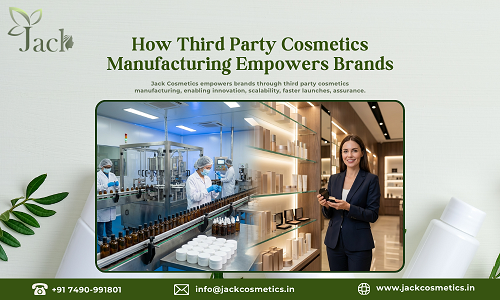
The global beauty and personal care industry has undergone a significant transformation over the past decade. Consumer expectations are rising, regulatory frameworks are becoming more stringent, and market competition is more intense than ever. In this evolving landscape, understanding how third-party cosmetics manufacturing empowers brands is essential, as the Third Party Cosmetics Product model has emerged as a practical and strategic growth solution.
Today, private-label cosmetics are no longer confined to small startups. Established distributors, D2C founders, and international traders are increasingly relying on outsourced manufacturing to remain agile and competitive. Across India, the USA, and the UK, regulatory scrutiny has intensified, while export markets now demand well-documented, stable, and fully compliant cosmetic formulations.
Evolving Requirements for Contemporary Beauty Companies (Worldwide Perspective)
Current beauty enterprises operate within a rapidly changing landscape.
They necessitate:
- Quicker product development timelines
- Clear and open ingredient communication
- Formulations prepared for international shipment
- Consistent results across production runs
In the realm of cosmetic production, speed often dictates commercial success. Brands planning seasonal collections for Britain or summer-oriented sun protection items for the UAE cannot afford manufacturing holdups.
Cosmetic newcomers in India similarly face distinct hurdles. Many lack internal research and development setups or regulatory departments. International firms, conversely, must meet compliance benchmarks in regions such as Europe and Southeast Asia.
This is where utilising external manufacturing providers becomes a strategic asset.
What Constitutes an Externally Manufactured Cosmetic Item?
An Externally Manufactured Cosmetic Item is a beauty product manufactured at an established production site for a brand owner. The brand maintains control over promotion, market placement, and sales channels, while the manufacturer manages the formulation, creation, assessment, and packaging.
These items might encompass:
- Facial Moisturizer
- Sun Block
- Hair Wash
- Treatment Liquid
- Body Moisturizer
- Facial Cleanser
- Natural Beauty Products
- Traditional Indian Beauty Products
Why Brands Favour External Manufacturing for Externally Manufactured Cosmetic Items?
Seasoned cosmetic producers understand that not every business needs to establish its own factory.
1. Lower Initial Expenditure
Establishing a compliant beauty facility demands:
- Equipment investment
- Skilled personnel
- Quality testing infrastructure
- Regulatory paperwork systems
For new ventures and resellers, this outlay is often impractical.
2. Accelerated Entry to Market
- In the cosmetic production environment, development time is essential. An external manufacturer already possesses fundamental formulas, validated procedures, and testing frameworks. This significantly shortens the time until launch.
3. Regulatory and Production Assistance
- Brands operating in export territories frequently encounter documentation requirements such as ingredient disclosures, product information dossiers, and stability evidence. External manufacturers generally help compile these necessary items.
Formulation Excellence, Stability, and Performance
Excellence in cosmetics is not about extravagant claims. It centres on equilibrium and steadfastness.
Crucial formulation focuses involve:
- Appropriate blending of creams and lotions
- Controlled thickness in hair washes and cleansers
- Even distribution of active compounds
- Effective preservation methods
Safety, Adherence, and Regulatory Preparedness
Safety in cosmetics is an absolute requirement of production.
This involves:
- Microbiological screening
- Durability assessments
- Tracing of raw materials
- Accurate labeling
Businesses selling within India must adhere to local beauty regulations. Those sending products to places like the USA or parts of Europe must align with evolving ingredient and labelling standards.
While producers do not offer legal counsel, experienced sites remain informed about worldwide regulatory shifts. This reduces the likelihood of relabeling, product withdrawals, or shipment postponements.
Clear paperwork fosters confidence among distributors and compliance officers.
Packaging, Branding, and Adaptability in Customisation
Packaging serves a purpose beyond aesthetics—it relates to functional compatibility.
In cosmetic production settings, compatibility testing ensures that:
- Containers do not react adversely with the formulas
- Dispensers operate correctly
- Closures maintain a tight seal
Brands targeting Southeast Asia prefer lighter packaging for humid conditions. UK or European businesses might prioritise materials that can be recycled.
Manufacturing Technology and Quality Oversight
Dependable production hinges on process management.
Key components include:
- Regulated mixing temperatures
- Uniform batch dimensions
- Stainless steel production containers
- Sterile filling areas
Consistency across output is vital. If a hair wash varies in look or scent between production runs, consumer trust erodes.
Capacity for Growth and Supply Chain Dependability
Many brands start small but aim to expand.
A scalable external manufacturer can:
- Begin with smaller test runs
- Increase production volume as demand rises
- Ensure steady procurement of ingredients
Traders of exported cosmetics serving regions such as Africa or Latin America need predictable delivery windows. Resellers in nations such as Kenya or Nigeria often rely on stable supply arrangements.
Reliability builds enduring business connections.
Cost Effectiveness for Expanding Beauty Companies
Cost effectiveness is not about compromising standards.
It involves:
- Minimising errors during production
- Avoiding the need to redevelop formulas
- Reducing issues with packaging incompatibility
- Preventing regulatory setbacks
Stable production frameworks reduce the need for rework and waste. Predictable quality lowers customer dissatisfaction.
For growing businesses, this operational stability generates sustainable profit margins over time.
Export Preparedness and International Market Acceptance
Producing goods ready for international sale requires preparation.
Firms operating in areas like Australia or Canada might face requirements for ingredient openness. Markets in the Middle East often prioritise how long products last when exposed to heat.
Experienced external manufacturers are ready:
- Product specifications
- Batch production records
- Summaries of stability findings
Audits by buyers are becoming more frequent. Distributors anticipate clear documentation and professional production standards.
Acceptance on the global stage starts at the production site.
Integration into the Brand’s Business Plan
External manufacturing fits well into various commercial approaches.
- Direct-to-Consumer (D2C) Ventures
- Concentrate on marketing, online sales, and collaborations with influencers while outsourcing product development.
- Reseller-Focused Structures
- Importers and wholesalers can introduce their own product lines without constructing facilities.
- Global Growth
- Brands entering new territories can gauge interest through external production before committing capital to local facilities.
This adaptability lessens business hazards.
Guidance, Paperwork, and Ongoing Support
Manufacturing collaborations extend beyond the making phase.
Support might involve:
- Information on product knowledge
- Explanations of ingredients
- Help with label layouts
- Documentation regarding product lifespan
In cosmetic production settings, long-term cooperation enhances efficiency. Over time, manufacturers gain a better grasp of a brand’s market positioning and quality expectations.
This alignment improves product consistency.
Why Selecting the Right External Manufacturer Matters?
Not all production sites maintain the same quality benchmarks.
Key factors to assess include:
- Depth of manufacturing background
- Expertise in technical formulation
- Familiarity with regulations
- Candid communication
- Track record of batch consistency
Veteran cosmetic producers recognise that dependable service is more valuable than bold marketing assertions.
The choice of partner affects the product’s standing, distributors’ confidence, and the capacity for long-term expansion.
Regarding Jack Cosmetic Pvt. Ltd
Jack Cosmetic Pvt. Ltd is an experienced external cosmetic producer serving local Indian and international territories. The firm collaborates with brand owners, distributors, exporters, and new enterprises across numerous cosmetic categories, including skincare, haircare, natural remedies, and specialised products such as Prickly Powder Cosmetic Products.
With structured production methods, quality assurance frameworks, and support for export-focused documentation, Jack Cosmetic Pvt. Ltd helps brands establish compliant and expandable product ranges.
Further details are accessible at:
👉 https://www.jackcosmetics.in/
In Summary:
The Externally Manufactured Cosmetic Item approach offers a practical route for beauty companies seeking quality, adherence, and scalability without substantial investment in infrastructure.
From ensuring formula balance and safety testing to checking packaging compatibility and preparing export paperwork, external manufacturing supports brands through every phase of development.
For beauty brand owners, D2C originators, resellers, and export traders, partnering with a trustworthy production facility can streamline operations and bolster market standing.
Opting for proven experience over quick fixes establishes enduring stability within the beauty sector.
Core Takeaways
Product Excellence & Uniformity rely on managed formulation and production schedules.
- Regulatory & Safety Preparedness supports both domestic and overseas markets.
- Faster Time to Market shortens development duration
- Manufactural Scaling supports business ascent
- Worldwide Demand for the Beauty Market necessitates professional production benchmarks.
FAQs
1. What is the manufacturing process for Externally Manufactured Cosmetic Items?
- It is a production arrangement in which a professional cosmetic facility produces goods on behalf of a brand owner, who subsequently markets and sells them under their own brand identity.
2. How is the longevity of cosmetic items assessed?
- Longevity is evaluated through stability testing under controlled temperature and humidity conditions to assess texture, scent, colour, and microbial safety over time.
3. Are Externally Manufactured Cosmetic Items appropriate for export?
- Yes, provided the formulas, labelling, and paperwork meet the regulatory standards of the intended destination.
4. What distinguishes private label from external manufacturing?
- Private label usually involves existing formulas with minor customisations. External manufacturing may include bespoke formulation, selection of packaging, and aid with regulatory documentation.
#ThirdPartyCosmeticManufacturing #PrivateLabelCosmetics #CosmeticManufacturer #HaircareManufacturing #SunCareCosmeticsProduct #JackCosmetic #CosmeticExport #BeautyBrandStartup #GlobalCosmetics