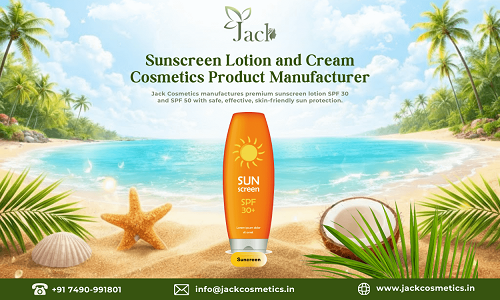
Innovative Sunscreen Lotion and Cream Cosmetics Manufacturing by Jack Cosmetics
The cosmetic industry has seen remarkable evolution over the past decade. What once focused solely on mass-market products has now shifted toward personalization, private-label opportunities, and compliance-driven formulations. Today, brands are not only competing in India but also striving to meet expectations in export markets such as the USA, UK, UAE, and Southeast Asia. Amid these dynamics, products like SunScreen Lotion and Cream Cosmetics Product Manufacturer have emerged as essential offerings for both skincare-focused brands and full-range beauty portfolios.
In cosmetic manufacturing environments, private-label products are increasingly favored for their efficiency, scalability, and adaptability. At the same time, brand owners face mounting pressure to differentiate in crowded markets, meet regulatory requirements, and maintain consistent product quality. Third-party cosmetic manufacturing provides a solution to these challenges, helping brands streamline operations while ensuring compliance and innovation.
Changing Needs of Modern Cosmetic Brands (Global View)
Cosmetic brands today operate under faster timelines, shifting consumer preferences, and stricter regulatory landscapes. Key challenges include:
- Faster Product Launches: Brands need to respond quickly to trends without compromising quality or compliance.
- Clean Beauty & Sustainability Trends: Consumers in Europe, North America, and Southeast Asia increasingly demand eco-friendly, transparent ingredient lists.
- Export-Ready Formulations: Companies exporting to markets like the USA or UAE must adhere to international labeling, ingredient, and safety requirements.
- Consistency & Scalability: For distributors and D2C operations, uniform product quality is non-negotiable.
Brands operating in export markets often face delays if formulations are inconsistent or packaging fails regulatory scrutiny. Experienced cosmetic manufacturers understand these pressures and integrate flexible solutions into their production workflows.
What Is a SunScreen Lotion and Cream Cosmetics Product?
In simple cosmetic-industry terms, SunScreen Lotion and Cream Cosmetics Product refers to body and face formulations designed to provide external skin coverage. These products are widely used in daily skincare routines and are expected to meet basic consumer expectations such as:
- Smooth application and even texture
- Compatibility with multiple skin types
- Non-sticky and aesthetically pleasing formulation
- Stability over time under various environmental conditions
While not medical or therapeutic, these products require careful formulation and manufacturing to ensure consistent texture, shelf life, and safety for diverse markets.
Why Brands Prefer Third-Party Manufacturing?
Third-party cosmetic manufacturing has become a strategic choice for brands for several practical reasons:
- Reduced Setup Costs: Starting a cosmetic brand without investing heavily in plant and machinery.
- Faster Go-to-Market: Leveraging ready manufacturing infrastructure to meet seasonal or trend-driven demand.
- Regulatory & Manufacturing Support: Third-party manufacturers provide guidance for labeling, compliance testing, and export documentation.
For example, an Indian D2C skincare startup exporting to the UK can quickly launch a SunScreen Lotion and Cream Cosmetics Product without navigating complex regulatory approvals internally, thanks to experienced third-party partners.
Formulation Quality, Stability & Performance
Ensuring the right ingredient balance and texture consistency is critical in cosmetic manufacturing:
- Texture & Spreadability: A consistent feel and non-greasy finish enhance user experience.
- Shelf Stability: Products must maintain quality over months under temperature variations.
- Performance Reliability: Uniformity in formulation prevents batch-to-batch variations that can impact consumer trust.
Experienced manufacturers test for these parameters under controlled conditions, ensuring that the product meets both domestic and international quality expectations.
Safety, Compliance & Regulatory Readiness
Safety and regulatory compliance are non-negotiable in global markets:
- Product Safety Testing: Includes stability, microbial, and preservative efficacy evaluations.
- Labeling Accuracy: Ingredients, manufacturing dates, and batch numbers must adhere to global labeling norms.
- Export Documentation: Compliance with country-specific regulations (FDA in the USA, EU Cosmetics Regulation, GCC standards) is essential.
Brands operating in export markets often rely on manufacturers to ensure documentation readiness and regulatory conformity.
Packaging, Branding & Customization Flexibility
Packaging plays a key role in product acceptance:
- Compatibility: Tubes, jars, and pump bottles must preserve formulation integrity.
- Branding Support: Third-party manufacturers provide co-branding or private-label options.
- Market-Specific Customization: For instance, sun-care products for Middle East markets may have unique SPF labeling or Arabic language requirements.
Flexibility in packaging allows brands to maintain distinct positioning without altering the underlying formulation.
Manufacturing Technology & Quality Control
Modern cosmetic production relies on advanced manufacturing technology:
- Batch Consistency: Automated systems ensure the same quality across small and large batches.
- Hygiene Practices: Cleanroom environments and GMP-compliant processes prevent contamination.
- Traceability: Every batch is documented for ingredient sourcing and production details.
Such precision is critical for export-oriented brands where distributors expect flawless consistency.
Export Readiness & International Market Acceptance
Export readiness is central to modern cosmetic strategy:
- Formulations must meet international regulatory expectations.
- Brands should anticipate buyer audits and distributor quality checks.
- Packaging and documentation need to align with local import norms.
A SunScreen Lotion and Cream Cosmetics Product manufactured with global standards in mind is easier to introduce to markets like Canada, Malaysia, or Latin America.
Why Choosing the Right Third-Party Manufacturer Matters?
Selecting the right partner is critical for operational success:
- Experience: Knowledge of formulation nuances, batch consistency, and ingredient sourcing.
- Regulatory Understanding: Awareness of domestic and international compliance expectations.
- Consistent Support: Timely production, troubleshooting, and documentation assistance.
Brands operating in export markets often face challenges when manufacturers lack these capabilities, leading to delays or quality issues.
About Jack Cosmetic Pvt. Ltd
Jack Cosmetic Pvt. Ltd is a trusted third-party cosmetic manufacturer serving Indian and international markets. With expertise in SunScreen Lotion and Cream Cosmetics Product and other skincare formulations, they provide scalable solutions for private-label and export-oriented brands. Experienced in navigating regulatory frameworks and maintaining high-quality manufacturing standards, Jack Cosmetic Pvt. Ltd has established long-term partnerships with brands across India, the USA, UK, UAE, and Southeast Asia. Learn more at 👉 https://www.jackcosmetics.in/.
Conclusion:
For cosmetic brands, a professionally manufactured SunScreen Lotion and Cream Cosmetics Product represents a strategic asset. It ensures product consistency, regulatory compliance, and export readiness while enabling faster market entry and scalable operations. By leveraging third-party expertise, brands can focus on growth, distribution, and consumer engagement rather than production challenges.
Key Takeaways
- Product Quality & Consistency: Batch-to-batch reliability ensures brand trust.
- Regulatory & Safety Readiness: Compliance with international standards is essential.
- Faster Market Entry: Third-party manufacturing accelerates launch timelines.
- Scalable Manufacturing: From small batches to bulk exports, production can grow with demand.
- Global Cosmetic Market Demand: Aligning formulations with diverse international markets enhances business potential.
FAQs
1. What is the typical shelf life of SunScreen Lotion and Cream Cosmetics Product?
- Shelf life usually ranges between 24–36 months, depending on formulation and packaging. Stability testing is recommended for export readiness.
2. Can third-party manufacturers support private-label branding?
- Yes. Experienced manufacturers offer full branding support, from custom labels to packaging adaptations for domestic and international markets.
3. Are SunScreen Lotion and Cream products export-ready by default?
- Not necessarily. Formulations must meet international labeling, ingredient, and safety regulations for markets like the USA, EU, or UAE.
4. How do manufacturers ensure batch consistency?
- Through controlled production environments, automated processes, and quality checks at every stage of formulation and filling.
5. What regulatory compliance should brands be aware of?
- Export-focused brands must adhere to FDA regulations, EU Cosmetics Regulation, GCC standards, and other country-specific requirements.
#ThirdPartyCosmeticManufacturing #PrivateLabelCosmetics #CosmeticManufacturer #SkincareManufacturing #JackCosmetic #CosmeticExport #BeautyBrandStartup #GlobalCosmetics