Hair Care Manufacturing: A Practical Guide for Modern Cosmetic Brands
Introduction
The worldwide beauty goods sector has seen a major shift in the last ten years, propelled by changing consumer wishes and market forces. Currently, companies in India, the US, and the UK compete based on factors like swiftness, adherence to rules, and novel ideas, in addition to the excellence of their goods. The rise of own-brand cosmetics has opened new avenues while simultaneously heightening hurdles related to getting regulatory sign-off and setting their products apart. Within this environment, smart strategies for outsourced production of hair care items are vital, with skilled collaborators such as Jack Cosmetic Pvt. Ltd. assisting in streamlined and compliant product creation.
Concurrently, overseas destinations require greater openness, uniform quality, and thorough paperwork. In this evolving area, hair care goods have become one of the most frequently outsourced categories in contract cosmetic production, given their constant consumer need and formulation versatility.
Shifting Requirements of Contemporary Beauty Brands (Worldwide View)
Modern beauty brands operate in a rapidly changing sphere. The expected turnaround for introducing new products is shrinking, particularly in highly contested arenas like Europe and Southeast Asia.
Today’s brands seek:
- Recipes that are “clean” and streamlined, matching current trends
- Items suitable for export with ingredient lists that meet regulations
- Dependable collaborators capable of guaranteeing consistency between production runs
A frequent difficulty in cosmetic production settings is preserving high standards while increasing output. Brands in both domestic and global arenas often grapple with finding the right balance between new ideas and regulatory adherence, especially when entering territories like the UAE or Australia, which have stringent rules.
What Constitutes Hair Care?
In the context of the beauty industry, Hair Care denotes a grouping of mixtures intended for regular hair upkeep. This encompasses items such as shampoos, conditioners, specialised liquids, and treatments for the scalp.
These preparations are formulated to satisfy common consumer hopes like cleansing, ease of handling, and visual appeal. They are not medicines but are developed to follow cosmetic usage benchmarks, ensuring secure and uniform application across various consumer segments.
Motivations Behind Brands Opting for Contract Manufacturing for Hair Care
Outsourcing production has become a calculated move for many beauty companies.
Primary justifications include:
- Avoiding the expenditure of establishing complete production facilities
- Gaining access to seasoned expertise in formulation and manufacturing
- Accelerating the timeframe for bringing products to market
For instance, a direct-to-consumer venture in India aiming to sell internationally to Canada or the UK can significantly simplify its logistical burden by teaming up with an established producer. This frees the brand to concentrate on promotion, distribution, and the customer experience rather than production hurdles.
Insights shared on Coursera highlight that structured processes and expert-led production improve product consistency and innovation in smart hair care. Third-party manufacturing enables brands to adopt advanced formulations while focusing on market growth.
Safety, Adherence to Rules, and Preparedness for Export
Ensuring product safety and meeting regulations are paramount in cosmetic production. Experienced contract manufacturers understand that even minor deviations in the recipe or labelling can lead to regulatory issues.
Crucial elements include:
- Testing for product stability and material compatibility
- Accurate listing of ingredients on labels
- Appropriate record-keeping and the ability to trace every batch
Brands operating abroad frequently face heightened scrutiny. Markets like the US and Saudi Arabia, for example, demand clear paperwork and strict observance of specific cosmetic guidelines. Although regulatory systems vary, maintaining transparency and having documentation ready is vital everywhere.
Research perspectives from edX suggest that outsourcing production supports scalability and efficient resource utilization. For smart hair care brands, this ensures reliable quality and faster adaptation to evolving consumer trends.
Capacity for Expansion & Dependability of the Supply Chain
The ability to scale production is a major consideration for expanding beauty brands. A product that performs well in limited quantities must maintain the same standard when manufactured in greater volume.
In cosmetic production settings, scaling up relies on:
- Uniform manufacturing protocols
- Sourcing raw materials reliably
- Effective oversight of stock levels
For brands focused on exporting to areas like Southeast Asia or Africa, a steady supply becomes even more crucial across Personal Care, Hair Care, and Oral Health Care products. Any holdups or variations in quality can directly harm the brand’s standing in international arenas, making consistency and reliability essential for long-term success.
Financial Prudence for Developing Beauty Brands
Cost-effectiveness in cosmetic production isn’t solely about the per-unit manufacturing cost; it involves mitigating risks over the long haul.
Brands benefit from:
- Less need to rework products due to stable formulas
- Foreseeable production results
- Fewer instances of entire batches being rejected
Skilled cosmetic manufacturers ensure that processes are refined to prevent needless waste, helping brands sustain uniformity as they grow.
Educational insights from Khan Academy indicate that systematic production and quality control are essential for consistent results. Third-party manufacturing helps brands maintain these standards while reducing operational complexity.
Readiness for Export & Approval in Global Markets
Being prepared for export involves a mix of high-quality formulation, robust documentation, and packaging that complies with regulations.
Products intended for global destinations like Singapore, the Middle East, or Latin America must conform to local beauty standards. This encompasses:
- Rules regarding ingredients
- Labeling conventions
- Validation of the product’s usable lifespan
Manufacturers play a key role in ensuring items are prepared to meet these international demands before entering worldwide distribution channels.
Significance of Selecting the Correct Contract Manufacturer
Picking the right production associate is a pivotal choice for any beauty brand.
Key aspects to assess include:
- Demonstrated history of successful manufacturing
- Familiarity with international regulatory structures
- Consistent output and ongoing assistance
Seasoned cosmetic manufacturers recognise that durable collaborations are built on dependability, not just the initial delivery.
About Jack Cosmetic Pvt. Ltd
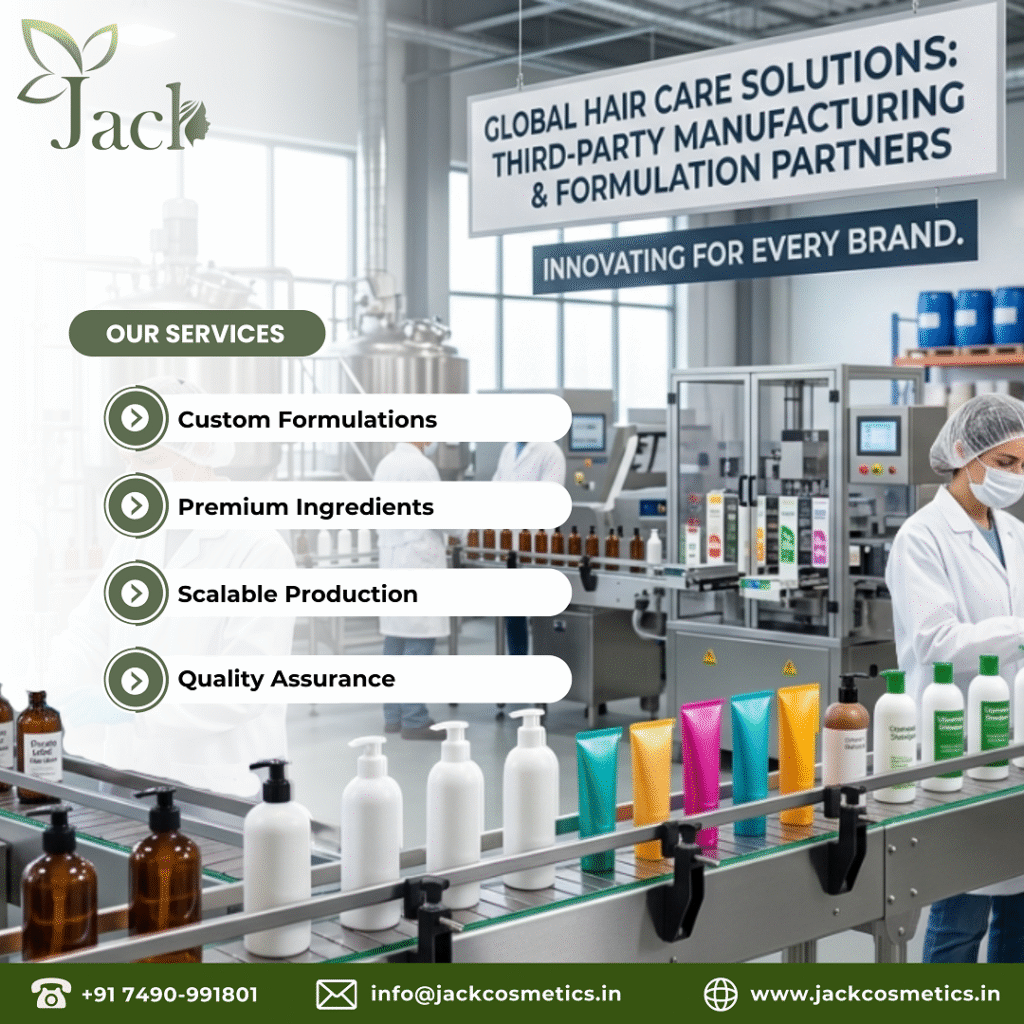
Jack Cosmetic Pvt. Ltd. is an established contract cosmetic manufacturer that supports brands throughout India and in overseas territories. Focusing on practical production methods, awareness of regulations, and scalable output, the firm partners closely with brand owners, exporters, and distributors.
Ready to grow your Smart Hair Care brand? Partner with Jack Cosmetic Pvt. Ltd. for expert third-party manufacturing solutions.
Summary
Hair care items maintain a key position in the global beauty industry due to their steady demand and adaptability, for brands aiming to expand both locally and internationally, engaging in third-party production offers a structured and effective route forward.
By concentrating on excellence, compliance, and scalability, brands can build trustworthy product lines that cater to evolving consumer desires. Choosing the right manufacturing collaborator ensures smoother operations and enduring viability in a demanding marketplace.
Vital Takeaways
- Product Superiority & Uniformity are vital for sustained brand confidence
- Regulatory & Safety Preparedness smooths the path to market entry
- Quicker Market Introduction aids in competitive standing
- Scalable Production allows for growth from local to global reach
- Demand in the Worldwide Cosmetic Market for Hair Care products continues to rise
FAQs
1. What is involved in Hair Care manufacturing?
- It includes formulation development, raw material sourcing, production, testing, and packaging under controlled conditions.
2. What is the typical shelf life of Hair Care products?
- Most products range between 24 and 36 months, depending on formulation stability and packaging.
3. How can brands ensure export readiness?
- By following proper documentation, labelling standards, and compliance with destination country regulations.
4. What is the difference between private label and third-party manufacturing?
- Private label uses pre-developed formulations, while third-party manufacturing may include custom formulation and production.
5. Are Hair Care products subject to regulatory approvals?
- Yes, they must comply with cosmetic regulations, labelling requirements, and safety standards in each target market.
ThirdPartyCosmeticManufacturing #PrivateLabelCosmetics #CosmeticManufacturer #SkincareManufacturing #JackCosmetic #CosmeticExport #BeautyBrandStartup #GlobalCosmetics