Trusted Skin Care Third Party Manufacturing Partner for Emerging Brands: Jack Cosmetics
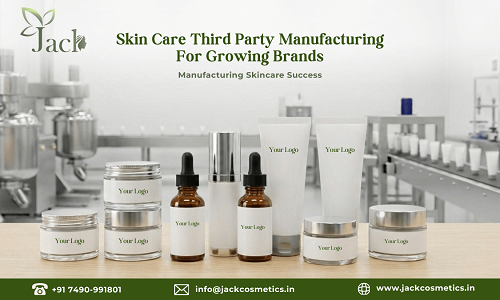
The global cosmetic industry has evolved rapidly over the past decade, reshaping how beauty and personal care brands bring products to market. In today’s cosmetic manufacturing landscape, brand owners face rising demand for private-label cosmetics, stricter regulatory requirements, and intense competition across crowded product categories. Brands operating in India, the United States, the United Kingdom, and export-driven markets are expected to launch innovative products faster—without compromising on quality, safety, or compliance. This shift has made Skin Care Third Party Manufacturing For Growing Brands a strategic solution for companies looking to scale efficiently.
In this power, the skin care product family remains one of the most far-flung and commercially viable segments. It includes mellow-demand formats such as look creams, sun products, shampoos, serums, moisturizers, face washes, and herbal or ayurvedic cosmetics. These daily infrastructures provide an idealistic jump for brand growth, as they fulfill the current wants of consumers and can be scaled when formulations, quality systems, and manufacturing processes are properly grounded.
Changing needs of modern cosmetic stigma (global view)
Craft markers operating in exploration arts are often subject to different pressures than national players. Today, cosmetics marques need,
- Faster product maturation and introduction here
- Proper positioning of beauty without compromise in stability
- Exploration-ready rules adapted to the anticipation of support
- Consistency between quantities was when they increased
Amerindian brands that farm in strange groceries often struggle to document and audit buyers. International brands that purchase product centres in Asia expect a predictable tone, traceability of crude materials, and precise batch numbers. These operational worlds characterized the structuring of partnerships between third parties.
What is an enhanced production for skin care?
In simple terms, a cosmetic hide concern product refers to formulations of topical products for routine hygiene or to enhance concern. Examples:
- Cleansing products such as aspect washing or shampoo
- Inflatable products such as cream, applications, and serum
- Solar care products for day-by-day outdoor exposure
- Enhance products inspired by herbs and Ayurvedics used in traditional beauty routines
These products are designed for genuine consumer enjoyment and must meet the requirements for constant guard and labelling. These are not medical interventions. Consumer expectations are loosely based on texture, redolence, permissiveness, ease of enjoyment, comfort, publicity, and shelf stability under normal storage conditions.
Why do brands prefer the third company’s industry for skin care and decorative production?
Third-party products allow marques to focus on market development rather than on operating facilities. In enhanced manufacturing environments, this example assists:
- Deoxidized installation costs: no need to invest in expression laboratories, filling facilities or submission teams
- Accelerating marketing: inventing infrastructure ready to be deoxidized
- Regulatory and manufacturing help: documentation, coordination of runs and product restraints are dealt with by experiment teams
For example, a D2C skincare brand can test market demand with a limited amount of facial cream before committing to increasing production volume.
Quality, stability, and execution rule
The priority orbits are:
- Fixing balance: emulsifiers, additives, and preservatives must cooperate
- Consistency of texture: the product must have the same appearance and feel beyond batches
- Shelf life: productions should remain stable for the intended shelf life
In enhanced fabrication environments, stability trials, stage separation, viscosity alterations, or perfume instability can be detected over time.
Safety, submission, and regulatory happiness
Safety and compliance are operational demands, not optional additional results. Brands active in export markets are often:
- Demands for product safety talks
- Accurate identification of fixings and traceability of lots
- Export support in accordance with the importer’s anticipation
Different realms have dissimilar regulatory models. Although this is not practical advice, producers supporting international distribution often implement intragroup procedures to meet audit standards and obtain documentary confirmations from buyers’ regions, such as Europe and the Middle East.
Promotion, branding & adaptation flexibility
Packaging is not only about appearance, but also about production stability and relaxation.
Manufacturers shall tax:
- Publicity compatibility with expression (pump, hose, glass)
- Change of textile with ingredients
- Assistance in guiding stigmatization techniques, such as sizing dispersion and placement of works of art
- Market-specific versions (e., Multilingual export labels)
For marques exporting to the Middle East or Southeast Asia, publicity formats and label languages may vary depending on distributors’ expectations.
Manufacturing & quality control technology
Complicated and consistent schemes ensure the reliability of the manufacture:
- Controlled intermixture and heat processes
- Set batch records and in-operation tests
- Hygiene production environs with documented cleaning subroutines
Lot consistency is essential, as allocations and importers expect products to be of the same quality. In cosmetic manufacturing environments, residual grain or fragrance can undermine confidence.
Possible and reliable provision chain
The capability is not only the product of units more
Dependable third-party manufacturing should support:
- Small pilot piles for grocery tests
- Average product for growth in the u
- Mass manufacturing for export demand
Reliability aspects of the supply chain include consistency in raw fabric supply, timely promotion, and predictable delivery times for external buyers.
Economical costs for growing cosmetics brands
The best price-effectiveness proportion is inferred over time, not per unit.
The detective-terminus value comes from:
- Simplification of shiftwork by stable expressions
- Less batch village
- Predictable calibre avoiding market complaints
Brands that frequently undergo re-engineering or publicity breakdowns often incur higher indirect costs due to recalls or distribution violations.
The willingness to export & acceptance of the international marketplace
The will to export is more than sending cartoons. Brands participating in exploration markets are often:
- Buyer audits on hygienics and documentation
- Distributor expectations on batch disks
- Adapted formulas for mood stability
Markets in Europe, Southeast Asia and shares of africa may have different logistic conditions. Productions must remain stable for extended periods during transportation and across different storage environments.
Integration into the brand’s occupation model
The manufacture of third companies is part of various commercial-grade models:
- Brands d2c: flying looping of new product lines
- Distributor marques: reproducible delivery for regional partners
- Outside extension: scalable product without overseas installation
This model allows brand teams to be more involved in merchandising, distribution, and customer feedback iterations.
Grooming, documentation, and ongoing documentation
Long-term partnerships focus on operating transparency.
Support shall commonly include:
- Production thesis breeding for marque teams
- Objective assistance for audits and distributors on board
- Coordination in progress in the event of updating the formulation or limiting the publicity
In enhanced manufacturing environments, clear documentation reduces rubbing during on-board emulation and exploration.
Why choose the correct third-party producer counts?
Choosing the right partner is a strategic decision. It touches:
- Reliability of production
- Awareness-fostering of the relevant authorities
- Response to large-scale challenges
Experienced enhancement manufacturers realize that consistent funding is as necessary as product capability. Brands gain from partners who can adapt operations as volume, markets, and submission expectations change.
Jack Cosmetic Pvt. Ltd is a third-party, experienced cosmetic product manufacturer operating in both the Americas and worldwide. The companionship offers a range of cosmetic skin care production formats that support revenue growth, controlled manufacturing, promotion coordination, and support for national and exploration-tailored marques. For more data on their product approach and capacity, please inspect https://www.Jackcosmetics.In/
Conclusion
Skin fear cosmetic classes remain a practical foundation for enhancing brands through their presence in the national and international marketplace. If these products are backed by experiment third-party supplier fabrication, they can switch from pilot clutches to reform-minded production without compromising consistency or compliance. For marque owners and exporters, opting for a manufacturing spouse with operating depth and regulatory expertise is a virtual step towards sustainable, long-term growth.
Key to take aside
- Product quality & coherence: stable formulations and reputable process cloth
- Readiness legislation and protection: refuge documentation and processes support export
- Speeding grocery entry: existing infrastructure shortens developing cycles
- Scalable manufacturing: from little batches to exported quantities
- World cosmetic product requirement: everyday products for skin care production remain widely used
FAQS
1. What does the industry of cosmetics by third parties imply?
- It includes outsourcing expression, product, pick, and packaging to a specialized producer, while the brand handles selling and sales.
2. How are the durability and consistency of hide fear cosmetics managed?
- Manufacturers conduct stability testing under verified conditions to control grain, odour, and physical consistency over time.
3. Are third-party products adapted to export groceries?
- Yes, if the documentation, identification, and restraint of the circles are in line with the venue and distributor’s expectations in the butt areas.
4. What is the difference between a secret and a foreign product?
- Secret-label products often feature pre-evolved formulations with brand changes, while third-party manufacturing enables outstanding formulation and packaging adjustments.
#ThirdPartyCosmeticManufacturing #PrivateLabelCosmetics #CosmeticManufacturer #HaircareManufacturing #SunCareCosmeticsProduct #JackCosmetic #CosmeticExport #BeautyBrandStartup #GlobalCosmetics