Top Sun Care Cosmetics Product Manufacturer for Global Brands: Jack Cosmetics Pvt. Ltd.
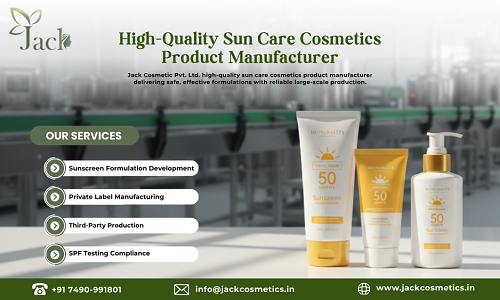
The global cosmetics industry has evolved rapidly over the last decade. High-Quality Sun Care Cosmetics Product Manufacturer partnerships are now central to brand success as product life cycles shorten, regulatory standards become stricter, and buyers compare quality across international markets. In today’s cosmetic manufacturing environment, brands are under increasing pressure to launch products reliably, maintain complete documentation, and comply with constantly evolving regulatory frameworks.
Interest in private-label cosmetics keeps growing as both new ventures and existing companies seek quicker ways to reach the market without needing their own production setups. Simultaneously, more rigorous regulatory checks are emerging throughout India, the USA, the UK, and various export destinations. With similar items appearing on shelves around the same time, setting brands apart has become trickier. Consequently, businesses are paying closer attention to formulation exactness, packaging suitability, testing for longevity, and reliable execution of the supply chain.
Evolving Requirements of Contemporary Cosmetic Lines (Worldwide Perspective)
Today’s brands operate under fast-paced launch schedules. Whether supplying local retail or international destinations, they need accelerated product development cycles without sacrificing necessary paperwork or durability assessments.
Key changes influencing manufacturer expectations involve:
Quicker product rollouts: Shorter periods from R&D completion to market availability, with clear records for every batch.
- “Clean beauty” trends: A preference for openly sourced ingredients and simple labelling.
- Formulations prepared for export: Products designed to meet various regulatory standards from the outset.
- Uniformity and ability to increase volume: The capacity to achieve consistent results across small trial batches and large commercial runs.
Brands active in international trade often face added pressures. For instance, cosmetic startups in India must harmonise local production methods with the standards expected in the UK or Europe, while international firms bringing goods into India require dependable quality oversight and documentation preparedness.
What Constitutes a Sun Care Third-Party Cosmetic Item?
A Sun Care Third-Party Cosmetic Product is a sun-related cosmetic blend manufactured by a contracted partner on behalf of the brand owner. The brand directs the product’s image, packaging, and sales approach, while the manufacturer oversees formula development, production, testing, and batch documentation.
Simply put, these items are designed for integration into daily consumer usage—face treatments, sunscreens, or body moisturisers intended for regular application under normal conditions. Consumers generally expect:
- Pleasing feel and ease of application
- A consistent look throughout its usability period
- Packaging that holds up in different environmental conditions
- Unambiguous directions for use are printed on the label
This arrangement lets brand teams concentrate on sales channels and consumer education, relying on manufacturing allies for the technical aspects.
Why Brands Favour Contract Manufacturing for Sun Care Third-Party Cosmetics?
Using external manufacturers helps brands manage operational risks and allocate resources. Seasoned cosmetic producers recognise that establishing compliant production facilities demands significant time and investment.
Typical business motivations include:
- Lower initial outlay: Avoiding the need for in-house machinery, laboratories, or compliance departments.
- Speed to market: Utilising existing production infrastructure shortens lead times.
- Support for regulations and making: Access to standardised documentation and quality frameworks.
For example, a direct-to-consumer company aiming for a summer launch can finalise packaging and logistics while the manufacturer manages initial batches, stability checks, and planning for volume increases.
Quality of Formula, Durability, and Efficacy
The calibre of a formula is proven by its consistent performance under actual storage and use conditions, not just by the claims made. In cosmetic production settings, formulation specialists concentrate on:
- Harmonising components: Ensuring oils, thickeners, and preservatives work well together.
- Uniformity of texture: Making specific every output mirrors the approved standard sample.
- Long-term stability: Watching for signs of separation, colour shift, or changes in scent over time.
These efforts minimise returns and necessary corrections for brands and foster distributor confidence in the product’s reliability during shipment and storage.
Safety, Adherence, and Regulatory Preparedness
Safety adherence is a core operational function. Product safety testing, precise labelling, and export documentation are integrated into standard manufacturing routines.
Experienced cosmetic manufacturers understand that:
- Safety evaluations facilitate market entry, rather than serving as promotional points.
- Accurate labelling averts issues with customs and retailers.
- The documentation needed for export varies significantly by destination.
Brands selling into regions such as Europe or the Middle East often require additional compliance documentation and detailed tracking records. While this reflects an awareness of rules rather than direct legal counsel, it directly impacts whether shipments are accepted and how confident distributors feel.
Packaging, Brand Identity, and Adaptability
Packaging is functional as well as aesthetic—it must be compatible with the formula and transportation environments. Manufacturers check packaging options for:
- How materials interact with the product’s base
- Resistance to leaks during transit
- How well labels adhere in warm or damp climates
Branding and tailoring for specific markets allow teams to modify graphics, required information panels, and pack sizes for different regions without altering the fundamental formula.
Production Technology and Quality Oversight
Dependable manufacturing relies on controlled procedures rather than singular pieces of equipment. Comprehensive batch logs, hygiene protocols, and equipment calibration are more vital than just the size of the operation.
Quality assurance teams prioritise:
- Uniformity between batches
- Verification of cleanliness between different product runs
- Checks during the process to catch errors early
This reduces inconsistencies when moving from trial runs to complete commercial volumes.
Flexibility to Grow and Dependable Supply
Brands frequently begin with modest production runs to gauge market interest, then scale up rapidly if successful. Manufacturers need systems that can support both stages.
The capacity to scale involves:
- Seamless transition from sample batches to larger export quantities
- Securing consistent sources for raw materials
- Creating operational buffers for sudden seasonal demand surges
A steady supply is particularly critical for global purchasers managing distribution commitments across multiple territories.
Cost Effectiveness for Expanding Cosmetic Companies
Achieving cost efficiency in manufacturing is not about securing the lowest per-unit price. It involves minimising expenditures arising from avoidable errors over the long haul.
Lasting value comes from:
- Less rework due to stable formulas
- Fewer product withdrawals or required label changes
- Predictable quality across successive production cycles
This enables procurement departments to plan budgets more accurately and manage inventory risk.
Export Readiness and Global Market Acceptance
Formulas crafted with export considerations and the requisite documentation are prerequisites for market acceptance. Buyer inspections and distributor expectations focus on the clarity of processes, not solely on the item’s physical appearance.
Brands trading internationally often encounter:
- Requests for full batch traceability
- Proof of stability and material compatibility
- Facility inspections by overseas partners
Meeting these requirements builds trust with distributors in regions such as the UAE and Southeast Asia, where scrutiny of product quality is high.
Fit Within the Brand’s Operational Structure
Outsourcing production integrates with various ways brands operate:
- D2C ventures: Emphasise customer experience and logistics while externalising manufacturing.
- Distributor-centred models: Rely on consistent supply and paperwork to maintain channel trust.
- Global growth: Use compliant manufacturing as a foundation for entering new territories.
This interconnectedness enables product managers to align production, marketing, and distribution timelines.
Guidance, Paperwork, and Continuous Support
Durable manufacturing alliances often include knowledge sharing and assistance with paperwork. This might entail:
- Information sessions on the product for the brand’s staff
- Help prepare technical documents for buyers
- Regular reviews of the formula based on user feedback
In cosmetic production settings, this mutual learning smooths out hurdles as output and market reach expand.
The Importance of Selecting the Correct Contract Manufacturer
Choosing a production accomplice is a foundational business choice. Manufacturing expertise, grasp of regulations, and steady assistance determine whether a brand can expand without operational disruptions.
Seasoned cosmetic manufacturers realise that:
- Discipline in procedure safeguards brand standing
- Knowledge of rules minimises risks associated with shipments
- Clear, continuous dialogue prevents costly setbacks
This decision hinges on operational alignment rather than salesmanship.
About Jack Cosmetic Pvt. Ltd
Jack Cosmetic Pvt. Ltd functions as a contract cosmetic manufacturer, assisting Indian and international cosmetic companies across various product types, including sun protection and personal care items. The firm emphasises structured manufacturing workflows, documentation preparedness, and consistency in batch production for brands serving both domestic and export markets. Further details on their production methodology and service scope are available at 👉 https://www.jackcosmetics.in/.
In Summary:
Manufacturing Sun Care Third-Party Cosmetic Products provides a practical path for brands seeking dependable production capabilities, ready documentation, and scalable supply without establishing internal facilities. For teams developing a wider range of items—such as those adding Lip Care Third-Party Cosmetics Product ranges alongside sun care—structured manufacturing alliances help maintain uniformity across different product lines.
For brand owners and exporters, the chief benefits lie in dependable quality, operational transparency, and long-term manufacturing relationships that foster sustained global growth.
Essential Points to Note
- Product Excellence & Uniformity: Achieved through manufacturing processes that can be repeated
- Regulatory & Safety Compliance: Accurate paperwork and labelling are crucial
- Accelerated Market Entry: Existing facilities shorten timeframes to launch
- Scalable Production: Moving smoothly from small samples to export volumes
- Global Cosmetic Market Needs: Demand requires reliability across diverse regions
FAQS
1) What does third-party cosmetic manufacturing include?
- It typically covers formulation support, production, batch documentation, and coordination of basic safety and stability checks. Brands manage branding and distribution.
2) How is shelf life and stability handled?
- Stability is monitored through controlled testing and observation of physical changes over time. This supports storage and transport planning rather than product claims.
3) Are third-party manufactured products export-ready by default?
- Not automatically. Export readiness depends on documentation completeness, labelling accuracy, and buyer-specific requirements.
4) What is the difference between private label and third-party manufacturing?
- Private label often uses pre-developed formulas with branding changes, while third-party manufacturing may involve custom formulation and process alignment.
5) How do manufacturers support regulatory awareness?
- They maintain compliance documentation, batch records, and labelling checks aligned with common market expectations, without offering legal advice. #ThirdPartyCosmeticManufacturing
#ThirdPartyCosmeticManufacturing #PrivateLabelCosmetics #CosmeticManufacturer #HaircareManufacturing #SunCareCosmeticsProduct #JackCosmetic #CosmeticExport #BeautyBrandStartup #GlobalCosmetics